Showing posts with label Anna Politkovskaya. Show all posts

Friday, January 19, 2007

The Dangers of Keeping them honest

The Armenian - American, Hrant Dink, who had received death threats from nationalists for questioning Turkey's denial of an Armenian genocide, was shot in the head and killed today in front of his office in Turkey.

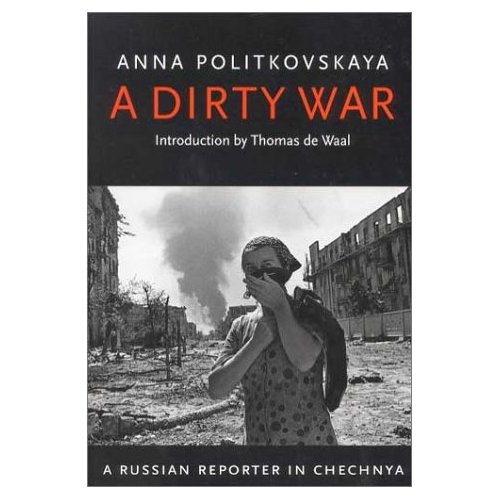
Last October, Russian Anna Politkovskaya, a leading investigative journalist and critic of President Vladimir Putin, was shot, contract-style, in her Moscow apartment building.


“When an internationally renowned reporter can be gunned down in her own apartment building and the perpetrators walk away free, it has a devastating effect on the press. Fewer tough questions are asked, fewer risky stories are covered, Her case shows why impunity is such a serious threat to press freedom, not only in Russia but in nations such as the Philippines, Colombia, Mexico, and Pakistan.”

Large corporations and powerful groups would do anything to just keep their dirt under their rugs. Could you imagine any media outlet daring to expose the real contracts and conditions of a powerhouse like Halliburton while Cheney is still the VP?

Paul Klebnikov, Forbes Russia
July 9, 2004
Moscow
Klebnikov, 41, editor of Forbes Magazine who exposed the workings of the country's shadowy billionaire tycoons, was killed outside his Moscow office. An American of Russian descent, he was struck several times by shots fired from a passing car.

Over the years, experience has demonstrated, that the attacks are done where the journalists are more vulnerable: their homes or office. Their families are often victims of hostilities, harassment and even abduction. Journalists are not celebrities. The more exposed they are in that matter, the more vulnerable and less capable they are to do their job without the added burden.

Many might be thinking, that doesn't´t happen in the USA. WRONG. More journalist are jailed here, companies threatened with losing their licenses or simply denying access to information. Something Rumsfield, Cheney and González have never doubt of doing and force.

After Hurricane Katrina struck New Orleans and the Gulf states on August 29, the Federal Emergency Management Agency urged news organizations not to photograph dead bodies. Numerous bodies were left in public areas for days after the hurricane amid a government recovery effort that was widely criticized for being slow and ineffective. The Washington Post reported that in at least one instance state authorities echoed the demand not to photograph the dead.


New Orleans police adopted an aggressive stance in several reported cases. On September 1, city police ripped a camera from the neck of Lucas Oleniuk of the Toronto Star and removed the camera's memory cards, robbing the photographer of more than 350 images. The seized images included "officers delivering a fierce beating to two suspects," the Toronto Star reported. The same day, Gordon Russell of the New Orleans–based Times-Picayune wrote that he and another photographer were slammed against a wall and had their gear thrown to the ground by police. On September 7, NBC News anchor Brian Williams reported that he and his crew were ordered to stop filming a National Guard unit securing a downtown store. "I have searched my mind for some justification for why I can't be reporting in a calm and heavily defended American city and cannot find one," Williams told The Washington Post.


On October 18, a New Orleans police officer was caught on film harassing an Associated Press Television News producer whose crew was filming two other officers beating a man suspected of public intoxication. Two of the officers were fired and one was suspended.

Maybe the pressure of the US government towards the media outlets is the main reason the international press call US Media "soft wimps", that have left the hard questioning to Jon Stewart of the Daily Show. And with the added disadvantage of the celebrity cult that persists in the USA, where TV journalists draw attention to the verge of invasion of privacy or simple good old stalking.

So please keep in mind, that the next time you come across of an image of Anderson Cooper´s apartment, his home address, his family´s whereabouts, his personal life, you are not only enjoying a piece of entertainment gossip, you are supporting his vulnerability and mining his capability to access information, and by that silencing one of the few voices that ¨keeps them honest¨.

Saturday, October 07, 2006

More on the Murder of Anna Politkovskaya

Photobucket - Video and Image Hosting
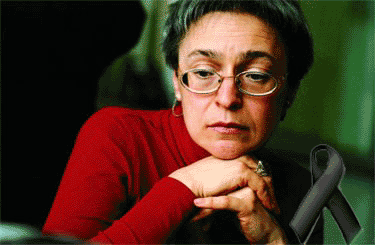
A man lays flowers in front of Russian journalist Anna Politkovskaya's house where she was found dead in central Moscow October 7, 2006.

MOSCOW, Russia (AP) -- A Russian journalist known for her critical coverage of the war in Chechnya was shot to death Saturday in the elevator of her apartment building in Moscow, in a killing prosecutors believe could be connected to her investigative work.

Anna Politkovskaya was a tireless reporter who had written a critical book on Russian President Vladimir Putin and his campaign in Chechnya, documenting widespread abuse of civilians by government troops.

Prosecutors have opened a murder investigation into her death, said Svetlana Petrenko, spokeswoman for the Moscow prosecutor's Office. Investigators suspect the killing was connected to the work of the 48-year-old journalist, Vyacheslav Raskinsky, Moscow's first deputy prosecutor, said on state-run Rossiya television.

Politkovskaya's body was found in an elevator in her Moscow apartment building, a duty officer at a police station in central Moscow told The Associated Press. Raskinsky said a pistol and bullets were found at the site of the crime. The RIA-Novosti news agency, citing police officials, reported that Politkovskaya was shot twice, the second time in the head.

Oleg Panfilov, director of the Moscow-based Center for Journalism in Extreme Situations, said Politkovskaya had frequently received threats. A few months ago, unknown assailants had tried unsuccessfully to break into the car her daughter Vera was driving.

In 2001, Politkovskaya fled to Vienna for several months after receiving e-mail threats alleging that a Russian police officer she had accused of committing atrocities against civilians was intent on revenge. The officer, Sergei Lapin, was detained in 2002 based on her allegations but the case against him was closed the following year.

"Whenever the question arose whether there is honest journalism in Russia, almost every time the first name that came to mind was Politkovskaya," Panfilov said.

Politkovskaya began reporting on Chechnya in 1999, during Russia's second campaign there, and concentrated less on military engagements than on the human side of the war. She wrote long, empathetic stories about the Chechen inhabitants of refugee camps and Russian soldiers she found in hospitals -- until she was banned from visiting those hospitals, Panfilov said.

More than any other Russian reporter, Politkovskaya has chronicled killings, tortures and beatings of civilians by Russian servicemen -- reports that put her on a collision course with the authorities.

"There are journalists who have this fate hanging over them," Panfilov said. "I always thought something would happen to Anya, first of all because of Chechnya."

Politkovskaya fell seriously ill with symptoms of food poisoning after drinking tea on a flight from Moscow to southern Russia during the school hostage crisis in Beslan in 2004, where many thought she was heading to mediate the crisis. Her colleagues had suggested the incident was an attempt on her life.

She was one of the few people to have entered the Moscow theater where Chechen militants took hundreds of hostages in October 2002 and tried to negotiate with the rebels.

"Anna was a hero to so many of us, and we'll miss her personally, but we'll also miss the information that she and only she was brave enough and dedicated enough to dig out and make public, and that's a loss that I'm not sure can ever be replaced," said Joel Simon, executive director of the New York-based Committee to Protect Journalists.

Politkovskaya's death is the highest-profile killing of a journalist in Russia since they July 2004 slaying of Paul Klebnikov, editor of the Russian edition of Forbes magazine.

Russia has become one of the deadliest places for journalists. Twenty-three journalists were killed in the country between 1996 and 2005, many in Chechnya, according to CPJ. At least 12 have been murdered in contract-style killings since Putin came to power, Simon said.

"None of those have been adequately investigated," he said. "We do know that record creates an environment where those who might seek to carry out this murder would feel that there would be few likely consequences."

In addition to her daughter, Politkovskaya is survived by a son, Ilya, Panfilov said.

During her career, Politkovskaya received more than 10 awards and prizes, including an award for human rights reporting from the London-based Amnesty International; a freedom of speech award from the Paris-based watchdog Reporters Without Borders; and a journalism and democracy award from the Organization for Security and Cooperation in Europe.

The Danger of Telling the Truth

"“People sometimes pay with their lives for saying out loud what they think. People can even get killed just for giving me information. I am not the only one in danger. I have examples that prove it.”Anna Politkovskaya

Report: Russian reporter dead, police think she was murdered

MOSCOW (CNN) -- A Russian newspaper reporter who has criticized Russia's Chechnya policy has died and police think she was murdered, a Russian news agency reported Saturday.

Interfax reported the death of Anna Politkovskaya, who worked for Novaya Gazeta. A neighbor found her wounded by a bullet late Saturday afternoon in her building's elevator.

A handgun and four cartridge cases were also found.

Dmitry Muratov, the newspaper editor, theorized that she was being punished for stories. A law enforcement source said a young man might have been involved in the incident and police were looking for him. (Posted 10:55 a.m.)

2003 Time Europe Magazine Hero

Mighty Pen: Politkovskaya braves the hell of Chechnya to get the truth
Disquiet On The Chechen Front

BY YURI ZARAKHOVICH MOSCOW
Anna Politkovskaya, a correspondent for the Moscow biweekly Novaya Gazeta, was in Los Angeles last October, picking out her dress for a media awards ceremony, when some staggering news came from Moscow: Chechen terrorists were holding 850 hostages in a theater. The Russian authorities tried to send in negotiators, but the Chechens refused to see most of them. They asked for Politkovskaya.
And so Politkovskaya rushed back to cover yet another episode of one of the world's nastiest and longest wars, which this time had shifted to Moscow. The terrorists, she says, "wanted someone who would accurately report things as they were. My work in Chechnya makes people there feel that I don't lie. But there wasn't much I could do for the hostages anyway." She carried water and fruit juice to them, and reported their dejection and feelings of doom to the world. Two days later, Russian special forces stormed and gassed the theater, killing 41 terrorists and 129 hostages.
Politkovskaya, 44, made her name by writing detailed, accurate and vivid reports on the plight of the civilian population in Chechnya, caught in the horrors of war since 1994. She tells stories of people who are taken from their homes at night and never come back; about extrajudicial executions; about the hungry refugees in cold and damp camps. "It was the refugee problem that started it," she now recalls. When the second Chechen war began in 1999, tens of thousands of refugees began flooding the makeshift relief camps. "It was horrible to stand among the refugees in the field in October 1999, and see cruise missiles flying over your head," she recalls.
When those missiles hit a market in Grozny, it was only prompt coverage by journalists like Politkovskaya that forced the Russian commanders to let ambulances in and refugees out. "Our work is a lever to help people as much as we can," she believes. But it also causes trouble. In February 2000, the FSB (the former KGB) arrested Politkovskaya in the Vedeno district of Chechnya. They kept her in a pit for three days without food or water. "It was important not to let them kill me on the first day," she says. A year later, a Russian officer whose war crimes Politkovskaya had exposed threatened to kill her. Novaya Gazeta had to hide her in Austria for a while. The officer is now awaiting trial on charges of war crimes committed in Chechnya that Politkovskaya was the first to report. "But I don't feel victorious," she says. "I only feel that we're all involved in a great tragedy."
Her editors have had to stand up to pressure from the Kremlin, which is often infuriated by her reporting. Novaya Gazeta balances on the brink of forcible closure. "Well, it goes with the job," she shrugs. Politkovskaya has long since learned to keep her anxieties in check. As she arranges yet another trip to Chechnya, she may now be too famous to be targeted by the FSB. But she really doesn't think about such things. "If you don't have the strength to control your emotions, you're of no help to the people who are in such shock and pain. You only add to their burden," she says.
©TIME. Published April 28, 2003

FreakSpeaker Note:
During the September tragedy in Beslan, award-winning journalist Anna Politkovskaya, while attempting to report and mediate in the crisis, was silenced by what has become known as the Kremlin's poison politics. After her recovery, Politkovskaya continued to report on human atrocities in the war-torn region and speak on behalf of the thousands of victims of Russia's 10 year campaign in Chechnya. In her first visit to the United States since Beslan, Politkovskaya discussed the upsurge in civilian casualties and Vladimir Putin's unequivocal drive toward authoritarianism. As the West is reconsidering its rapprochement with Russia, commentator Dr. Michael McFaul, Senior Fellow at Stanford's Hoover Institution, addressed the Kremlin's post-Beslan policies, growing public discontent with the Putin administration, and the implications and opportunities for U.S. policy.

Hear her speech HERE

2 German journalists killed overnight in northern Afghanistan

KABUL, Afghanistan (CNN) -- Two German journalists traveling in northern Afghanistan were killed overnight, Afghanistan's Interior Ministry and NATO's International Security Assistance Force said Saturday.

They were working for German news agency Deutsche Welle. The two -- who were on a road between Baghlan and Bamian province -- were killed by gunmen in Baghlan, said Zemari Bashary, Interior spokesman.

They had been spending the night in a tent by the road when they were killed around 1 a.m. Saturday. The location is north of the capital, Kabul.

Maj. Dominic Whyte, an ISAF spokesman, said they were operating independently of ISAF at the time of the incident.

It is not clear whether the perpetrators were Taliban, other militants or thieves. The area is not known for Taliban activity. But it does have some level of activity from a militant group called Hezb-e-Islami, led by Gulbeddin Hekmatyar, a renegade warlord. (Posted 10:20 a.m.)

MANIFESTO

Don't think for me. Don't assume what I want to hear or read. Give me facts. Give me reasons. But not yours. Bring me debate. Enlighten me. Today, accountability is masked behind anonymity; bylines are hidden by zeros and ones. Everyone publishes; everyone is "in the know." Ethics are non-existent. Speculation is king. The truth is masked and a hostage. Empowered by our minds, WE ARE THE FREAKSPEAKERS!

FAIR USE NOTICE

This site contains copyrighted material, the use of which has not always been specifically authorized by the copyright owner. We are making such material available in our efforts to advance understanding of issues of environmental, political, news and humanitarian significance. We believe this constitutes a "fair use" of any such material as provided in section 107 of the US Copyright Law. In accordance with the title 17 U.S.C. Section 107, the material on this blog is distributed and available without profit to those who have expressed a prior interest in receiving the included information for research and educational purposes.

If your obsession against us and our content endures, you might find more information at: Law.

If you wish to use copyrighted material from this site for purposes of your own that go beyond "fair use", you must obtain permission from the blog owner.