Tuesday, November 07, 2006
Monday, November 06, 2006
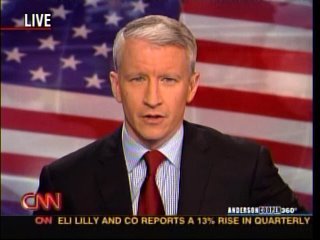
It will be a hard week for Anderson Cooper, CNN and most media outlets

Political pressure mounts on decision desks
By Paul J. Gough
Nov 6, 2006
A handful of men and women will gather at each network's headquarters Tuesday for their biennial all-nighter.The stars of election coverage don't have the name recognition of Katie, Brian or Charlie. Most are consultants, with expertise in such fields as political science or statistics who only work for the networks during the election. Viewers rarely see them on the air, but they form the backbone of the night's coverage. What they do is a fast-paced, high-pressure mix of math, computer modeling, political science, memory and sheer gut instinct that leads networks to call winners and losers.
The stakes are high. No one wants a repeat of 2000, when networks prematurely called Florida for Al Gore before having to retract.And the networks -- and the National Election Pool, a consortium that provides exit-poll results -- don't want a repeat of 2004, either, when early polls leaked on Web sites seemed to give John Kerry the lead over President Bush.
"It's pretty stressful. It's the kind of thing that very few jobs have, where you have to be right 100% of the time," said Sheldon Gawiser, who runs NBC News' decision desk."You don't want to go on (with predictions) and be wrong, but you don't want to be slow, either," said CBS News senior vp Linda Mason, who ultimately decides whether her network's decision desk verdict goes on the air. "It's a funny mix."
The decision desks' work goes on mostly without interference from on-air or behind-the-scenes personnel. There are elaborate double- and triple-checking processes, but no network allows pressure on the decision desk to speed up its work."After 2000, there's been a realization to just let the analysts do their job," said Dan Merkle, who runs ABC's decision desk.
"We have a policy at NBC that nobody is to pressure me on anything and I don't know what calls are made by other networks," Gawiser said. "We try to do the best job we can. We call it whenever we call it, when we are as sure as we can be."Unlike 2004, when the Bush-Kerry race took precedence, there are hundreds of races nationwide that the networks will monitor to see which party has won control of the House and Senate. There are 435 House and 33 Senate seats up for grabs Tuesday and a number of gubernatorial races. That in itself would be a daunting task because there are about 50 races where the rubber will meet the road and with no exit polls for House races.
"House races are historically difficult to look at because you don't do exit polls on congressional districts," said Marty Ryan, executive producer of political coverage at Fox News.But it's complicated even further by new voting machines and methods in an estimated 60% of the country, which could either speed or (more likely) slow the speed of results from the local level to the Associated Press, which tabulates them and sends them out to the networks. The AP real-time election results are paired with exit polls in the races where they exist to help the networks call elections.
"I can't remember an election where there has been such a great wholesale change of voting technology," CNN political director Keating Holland said.And that is what Gawiser calls the "greatest concern" going into election night."We have so many counties with new equipment, vote-counting equipment; we're going to have problems in places," he said. "If you can't trust the votes that are counted coming into our models, it's very difficult to go out on a limb and make a prediction. We're going to be cautious, as we always are, but it's just going to be a real potential problem not knowing."Mason agrees."We don't know how it's going to work," she said of Election Day. "We don't know how long it's going to take."
A change this year is new restrictions on the exit-polling results that came about after 2004. Instead of getting a "first wave" of exit polls at 1 p.m. EST, the networks will have to wait for all three waves until 5 p.m. EST before the full decision desks get their hands on them. Each network will have two representatives in a so-called quarantine room with access to the results, but they won't be able to contact New York until 5 p.m. That means there are only two hours between receiving exit poll results and when the first polls themselves close."It'll be a challenge," said ABC's Merkle, though he adds that the early exit-polling data needed to be taken with a grain of salt anyway. "You don't want to go to town based on a third of a poll."CNN's Holland agrees."I always think it's a scoreboard in a baseball game or a football game," he said. "If you see in the third inning that a team is off by five runs, does that mean that they're not going to win? Maybe, maybe not."Several networks, including CBS and Fox News, aren't just relying on the traditional streams of data.
Fox News will conduct its own polls in seven states to get another layer of information that its decision desk can use to help decide. Ryan calls it Fox News' "insurance policy."CBS learned from the 2000 election malfunction that it needed something beyond the science. Not only do they have experts in politics and math, but they also have added people with good political instincts to help determine whether the results are on target or not. And Mason said that CBS News is hiring stringers to help find out if there are unusual things like heavy turnout or irregularities in such places as Ohio and Missouri, where there have been problems in the past."There's nothing like people on the ground," Mason said.
Each network decision desk has been ramping up, conducting at least weekly dry runs since the summer with simulated data streams from the AP and NEP. Each member is prepared to pull the all-nighter because the work will begin in the late morning or early afternoon on Election Day and continue, even without a contested election like 2000, well past the networks' morning shows.But through it all, one maxim remains vital for every decision desk.
"Our instruction is to get it right, not first," ABC's Merkle said.
Thanks to Chifan9 for the screecap.
Publicado por MediaDoc en 5:58 AM 3 comentarios
Etiquetas: Anderson Cooper, Elections, Media Coverage
Election night could be a long one for media
NEW MACHINES, EXIT POLLS MIGHT SLOW RESULTS
By David Bauder
ASSOCIATED PRESS
NEW YORK - With public interest running unusually high, this year's midterm elections pose tough challenges for the vote-counting and exit poll operations that major news organizations rely on to provide speedy word about the outcome.
The system for tabulating votes, run by The Associated Press, will have to deal with a greater than normal number of polling places that are using new voting machines, increasing the possibility of glitches or delays.
And the consortium formed by ABC, CBS, NBC, CNN, Fox News Channel and the AP to conduct exit polls on Election Day has made changes to prevent a repeat of problems experienced in 2004. That year, early poll results were leaked to the Internet and created a misleading picture of how the presidential race was going. Later exit poll results also were unreliable in some cases because of problems that included insufficient training of interviewers.
The 2006 midterms are being watched especially keenly because Democrats are hoping to ride public anger about the Bush administration's handling of the war in Iraq to take control of the House and Senate away from Republicans.
"We're prepared for a late night, maybe being here all night and into the next morning," said Dan Merkle, ABC News decision desk director. ABC, CBS and NBC plan one-hour prime-time specials and periodic updates, while cable news networks will follow the elections full-time.
As they did in 2004, the networks will rely solely on the AP to tabulate returns. The AP employs stringers in nearly every U.S. county, or every city and town in New England, to call in results of more than 6,000 state and local races to one of more than a dozen tabulation centers, with regional hubs in New York and Spokane, Wash. The earliest returns begin to trickle out shortly after 6 p.m. ET, when the first polls close in Indiana and Kentucky, and the pace quickens to a peak between 10 p.m. and midnight ET.
Updated counts are sent to newspapers, broadcasters and Web sites every few minutes.
In a typical year, 5 percent of counties are dealing with new voting equipment at some of their polling places. This year, it's 60 percent.
Several problems surfaced during primary elections this year. Equipment trouble in Chicago caused very late results there. A software bug prevented many counties in Florida from delivering precinct totals. Up to 20 percent of California's vote wasn't counted on primary night, according to an AP analysis.
"There's always something," said Sandy Johnson, the AP's Washington bureau chief, "and if you're in the business of counting votes and calling elections as the AP is, you take that into consideration and are as careful and accurate and fast as you can be."
While exit poll information will be used to help call Senate and governor's races, news organizations for the most part have to rely on the actual results in House contests to make their calls. The increased number of mail-in or provisional ballots also works against quick resolutions.
"That makes this potentially a very exciting election night," said Kathleen Frankovic, CBS News director of surveys.
Publicado por MediaDoc en 2:00 AM 0 comentarios
Etiquetas: Elections, Media Coverage, WOrk
Friday, November 03, 2006
Politics by Anderson Cooper

From 8/14/04 edition of USA Weekend
Why the conventions matter.
What unfolds onstage can have tremedous impact -- and intrigue.
I know, I know, in terms of drama, political conventions sure ain't
what they used to be. The bare-knuckle brawling and backroom deals
have given way to choreographed photo ops and tightly scripted
remarks.
But we should hardly dismiss the national conventions as banal
celebrations of the respective parties' primary campaign results.
Very human, and compelling, performaces are still played out, and
what unfolds onstage often has tremendous impact on the ultimate
outcome. That's why conventions still matter.
The first convention year I really remember is 1976, when the nation
met a former naval officer, Georgia governor and peanut farmer named
Jimmy Carter. He was able to convey such a sense of warm, genuine
humanity that we won over America and won the election. Next came
Ronald Reagan. The 1980 convention that paved the way for his
presidency electrified audiences with pageantry, and his personality
seemed to really come through.
We often see our presidents "grow up" under the convention
spotlight. Remember the 1988 Democratic convention, when a young
Arkansas governor named Bill Clinton stumbled through a tedious 32-
minute speech praising the nominee, Massachusetts Gov. Michael
Dukakis -- a much-criticized performance that damaged Clinton's
nation standing? (He had been allotted 15 minutes.) He quickly
recovered, going on The Tonight Show to make fun of himself. "I
wanted so badly to make Dukakis look great," Clinton confessed to
host Johnny Carson, "and I succeeded beyond my wildest dreams." He
rebounded in his effort to get the White House. And for years
later, at the convention where he nailed the nomination, he proved
he had learned his lesson with an eloquent, soulful speech, defining
himself as a compassionate Everyman. "I still believe in a place
called Hope..." he said, ambiguously referencing the place of his
birth, Hope, Ark.
Clinton's vice president, Al Gore, took note. At the 1996
convention in Chicago, he tried to define himself in very human
terms. He spoke poignantly about a sister who had died. Then, at
the 2000 convention in Los Angeles where he was nominated for
president, Gore had his old roomie from Harvard, Oscar-winning
Fugitive actor Tommy Lee Jones, come onstage to talk up the
candidate as a guy he'd take "chasing through the woods with coon
dogs in the middle of the night." (It sounded better on TV.)
This year, the drama and intrigue continue. Who is chosen to
speak? Who's snubbed? Who gets prime time? Who fumbles reading
the teleprompter? At the GOP convention, party moderators are
expected to take the stage, national heroes such as former New York
mayor Rudy Giuliani and U.S. Sen. John McCain.
Plenty of issues can unite voters or futher deepen the divide --
Iraq, terrorism, the economy and gay marriage, for starters. Will
the convention stars lay them out and let the chips fall? Or will
they play down the issues and hit human notes instead? I hate to be
a tease, but really, the only way to find out is to tune in.
-Anderson Cooper is host of Anderson Cooper 360, which airs at 7pm
ET. He'll cover the Republican National Convention later this month.
Side note: There is a pic included with the article, but I
unfortunately do not have the capability to scan. The caption
reads, "Plenty of issues can unite voters or further divide us --
the economy, gay marriage, Iraq. Don't miss the action, says CNN's
Anderson Cooper"
Article credit: USA Weekend
Publicado por MediaDoc en 7:57 PM 1 comentarios
Etiquetas: Anderson Cooper, CNN, Elections, Politics
MANIFESTO
FAIR USE NOTICE
If your obsession against us and our content endures, you might find more information at: Law.
If you wish to use copyrighted material from this site for purposes of your own that go beyond "fair use", you must obtain permission from the blog owner.