
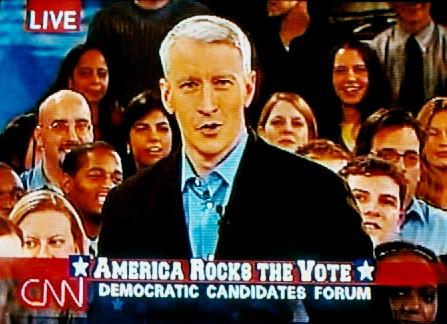
It will be a hard week for Anderson Cooper, CNN and most media outlets
Political pressure mounts on decision desks
By Paul J. Gough
Nov 6, 2006
A handful of men and women will gather at each network's headquarters Tuesday for their biennial all-nighter.The stars of election coverage don't have the name recognition of Katie, Brian or Charlie. Most are consultants, with expertise in such fields as political science or statistics who only work for the networks during the election. Viewers rarely see them on the air, but they form the backbone of the night's coverage. What they do is a fast-paced, high-pressure mix of math, computer modeling, political science, memory and sheer gut instinct that leads networks to call winners and losers.
The stakes are high. No one wants a repeat of 2000, when networks prematurely called Florida for Al Gore before having to retract.And the networks -- and the National Election Pool, a consortium that provides exit-poll results -- don't want a repeat of 2004, either, when early polls leaked on Web sites seemed to give John Kerry the lead over President Bush.
"It's pretty stressful. It's the kind of thing that very few jobs have, where you have to be right 100% of the time," said Sheldon Gawiser, who runs NBC News' decision desk."You don't want to go on (with predictions) and be wrong, but you don't want to be slow, either," said CBS News senior vp Linda Mason, who ultimately decides whether her network's decision desk verdict goes on the air. "It's a funny mix."
The decision desks' work goes on mostly without interference from on-air or behind-the-scenes personnel. There are elaborate double- and triple-checking processes, but no network allows pressure on the decision desk to speed up its work."After 2000, there's been a realization to just let the analysts do their job," said Dan Merkle, who runs ABC's decision desk.
"We have a policy at NBC that nobody is to pressure me on anything and I don't know what calls are made by other networks," Gawiser said. "We try to do the best job we can. We call it whenever we call it, when we are as sure as we can be."Unlike 2004, when the Bush-Kerry race took precedence, there are hundreds of races nationwide that the networks will monitor to see which party has won control of the House and Senate. There are 435 House and 33 Senate seats up for grabs Tuesday and a number of gubernatorial races. That in itself would be a daunting task because there are about 50 races where the rubber will meet the road and with no exit polls for House races.
"House races are historically difficult to look at because you don't do exit polls on congressional districts," said Marty Ryan, executive producer of political coverage at Fox News.But it's complicated even further by new voting machines and methods in an estimated 60% of the country, which could either speed or (more likely) slow the speed of results from the local level to the Associated Press, which tabulates them and sends them out to the networks. The AP real-time election results are paired with exit polls in the races where they exist to help the networks call elections.
"I can't remember an election where there has been such a great wholesale change of voting technology," CNN political director Keating Holland said.And that is what Gawiser calls the "greatest concern" going into election night."We have so many counties with new equipment, vote-counting equipment; we're going to have problems in places," he said. "If you can't trust the votes that are counted coming into our models, it's very difficult to go out on a limb and make a prediction. We're going to be cautious, as we always are, but it's just going to be a real potential problem not knowing."Mason agrees."We don't know how it's going to work," she said of Election Day. "We don't know how long it's going to take."
A change this year is new restrictions on the exit-polling results that came about after 2004. Instead of getting a "first wave" of exit polls at 1 p.m. EST, the networks will have to wait for all three waves until 5 p.m. EST before the full decision desks get their hands on them. Each network will have two representatives in a so-called quarantine room with access to the results, but they won't be able to contact New York until 5 p.m. That means there are only two hours between receiving exit poll results and when the first polls themselves close."It'll be a challenge," said ABC's Merkle, though he adds that the early exit-polling data needed to be taken with a grain of salt anyway. "You don't want to go to town based on a third of a poll."CNN's Holland agrees."I always think it's a scoreboard in a baseball game or a football game," he said. "If you see in the third inning that a team is off by five runs, does that mean that they're not going to win? Maybe, maybe not."Several networks, including CBS and Fox News, aren't just relying on the traditional streams of data.
Fox News will conduct its own polls in seven states to get another layer of information that its decision desk can use to help decide. Ryan calls it Fox News' "insurance policy."CBS learned from the 2000 election malfunction that it needed something beyond the science. Not only do they have experts in politics and math, but they also have added people with good political instincts to help determine whether the results are on target or not. And Mason said that CBS News is hiring stringers to help find out if there are unusual things like heavy turnout or irregularities in such places as Ohio and Missouri, where there have been problems in the past."There's nothing like people on the ground," Mason said.
Each network decision desk has been ramping up, conducting at least weekly dry runs since the summer with simulated data streams from the AP and NEP. Each member is prepared to pull the all-nighter because the work will begin in the late morning or early afternoon on Election Day and continue, even without a contested election like 2000, well past the networks' morning shows.But through it all, one maxim remains vital for every decision desk.
"Our instruction is to get it right, not first," ABC's Merkle said.
Thanks to Chifan9 for the screecap.





