Showing posts with label lecture. Show all posts

Wednesday, May 09, 2007

Video of Anderson Cooper's lecture at the Museum of Television and Radio

Thanks to our correspondent 00F for her account, and better yet, THE VIDEO! so you can hear it directly from the man himself!

Part 1


Part 2


Part 3


Part 4


Part 5


Just a reminder: it was video taped with consumer level equipment, we don't expect an Emmy for it....

Tuesday, May 08, 2007

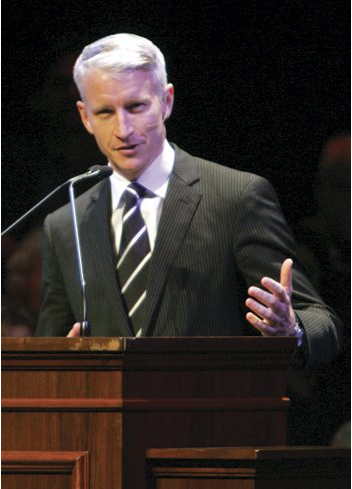
Photos of Anderson Cooper at the Museum of Television and Radio


Hi! As promised, our undercover agent 00F took this images and some video from Anderson's lecture at the Museum of TV and Radio for your viewing pleasure, I'm also trying to whip the agent to write a first hand account, including the small chat they had at the staircase... hmmm, let's see if 00F obliges...

  • He is planning to go to Iraq during the summer
  • Soon to Niger for 60 minutes
UPDATE:
Agent 00F comply with the request, so here it is:

Most memorable moments of the event.

by Agent 00F, Visiting New York Freak Correspondent

The lecture was really in a form of an interview with clips of his famous reports on a big screen. The start was a blunder – the host said something along the lines of that she never met him though worked on CNN in the past. And now she can see him in her bedroom a lot more often- Anderson was fast – oh, let’s not talk about it further with audience laughing. Host said she didn’t mean it the way it came out –but everybody was glad it did -)

Anderson talked briefly about his career and how thrilled his mom as to know he was going to go to wars. Later answering a question he said she’s happy for him now

He mentioned the dangers of conflict/war reporting. Admitted it is kind of addictive. He said there’s a line when you’re staying there too long and he knows colleagues who have been in war situation a few years and couldn’t adjust to normal life after that. Normal life seems to ordinary when you’re covering war and it’s easy to get lost.

He did talk about Afghanistan and that it’s frustrating for soldiers that that war is thought of as less dangerous then in Iraq. And that it was frustrating to plan the whole week there only to return to cover breaking news 48 hours later.

Anderson talked about Niger and that people don’t want to see those kind of stories- it’s a “turn-off TV”, but it’s still important to cover it and let the world know about people’s suffering. And that it’s very difficult for him to cover this kind of stories because he wants to be empathic and take in people’s stories but at the same time he needs to focus on getting the right level of sound and camera angles to capture the details and bring a viewer a compelling picture that reflects the atmosphere of what they’re seeing. It’s very hard to be split between being compassionate and thinking how to package the story

He was asked if CNN would let him go to Iraq –he said he was planning to go there few months ago but logistically something didn’t work out and he’s hoping to go in summer. Also he plans to go to Niger for 60 minutes.

He was asked what he thinks about the article talking about him being used as a symbol of emotional reporting (in a bad way). He disagrees with that, said that he’s less emotional then most other anchors and that it happened to him only once during Katrina. He tries to do balanced reporting, citing Niger as example of reporting style he has. He finds the kind of reporting when you hold crying babies and say how horrible it is too easy and sort of cheap and said some others are doing that. Having real human emotion and pushing fake ones on viewers are different things.

There was a question form the audience about difference of doing 60 Minutes and CNN. Anderson said it’s very different, he’s getting better at interviews and it’s like working out a different group of muscles.

Another question from the audience–sport stars want to be anchors, rock stars sport stars and so on. What would Anderson prefer –be a rock star or sport star- he said he would prefer to be a rock star, he knows nothing about sports it must be thrilling to perform on stage in front of thousands of people.

Ander q&a was over a few people went up to him to get autographs, he was very nice, polite and charming. He looks younger in person than on TV. I did hear it from other people and can confirm it myself -)

Monday, November 20, 2006

Anderson Cooper explains his life while in Iraq


Cooper talks Katrina and Iraq at Tate Lecture

Mark Norris, Managing Editor, mnorris@smu.edu
Posted: 11/15/06


Anderson Cooper gave advice to young journalists and discussed current events at the Jones Day Lecture of the Tate Lecture Series.Cooper said he had no idea of what he wanted to do when he graduated with a liberal arts degree from Yale. When he asked his mom, Gloria Vanderbilt, for advice, she told him to "follow your bliss."At the time, Cooper thought the advice was too vague, but now he appreciates what she told him.After winding his way through jobs at Channel One and ABC News, Cooper was hired at CNN. He currently hosts "Anderson Cooper 360."Cooper said his show differs from other cable programs because he tries to present both sides of the story. He said almost anyone could get a cable show now if they are opinionated enough."I'm not like most anchors...I don't like to hear myself speak, unlike most, like Lou Dobbs," Cooper said.He said the cable networks should stop trying to appeal to people's partisanship and instead focus on the facts."It seems we're encouraged to see things through our own views," Cooper said.Cooper, along with NBC's Brian Williams, has become associated with coverage of Hurricane Katrina.Cooper said he tries to keep the story in the public consciousness by hosting his show from New Orleans periodically. More than a year later, he says, the Lower Ninth Ward is "like a time capsule of incompetence."Cooper discussed the saga of trying to get New Orleans Mayor Ray Nagin to sit down for an interview. Nagin continued canceling on Cooper until one night when CNN found out Nagin was in a bar after telling the network he couldn't go on air due to an emergency meeting.After that incident Nagin finally sat down, but Cooper said the interview wound up not working out."I thought I got a good interview, but when I sat down to log it, it turned out I had nothing," Cooper said.The situation in Iraq took up the rest of Cooper's time, with him saying each time he goes back the scene on the ground gets worse."Iraq is the hardest story to tell right now because it's difficult to travel and get around," he said.Cooper said planes that land at the Baghdad airport must land in a corkscrew formation, in which the planes get in the airspace and make tight circles down until they land.When Cooper gets off the plane he said he is taken to a private compound outside the green zone that CNN owns. The network pays for its own guards who are former British special forces members.Reporting is difficult, Cooper said, because getting to talk to real people is nearly impossible. "If you are in a neighborhood for more than 15 minutes, the insurgents find out and word spreads and you have to get out," he said.Earlier in the day, Cooper spoke before one of the largest crowds in Student Forum history. Six hundred students were in the Hughes-Trigg Ballroom and nearly 500 were in the Hughes-Trigg Theater watching a simulcast.The final Tate Lecture of the fall semester is during final exams on Tuesday, Dec. 5. Malcolm Gladwell of The New Yorker will be speaking.
© Copyright 2006 Daily Campus

Saturday, November 18, 2006

Anderson Cooper Keeps it Positive


I really enjoyed last night show. Who can control Robin Williams! Anderson just let it flow. I have never saw him laugh that much, and the idea of Gloria Vanderbilt walking around Manhattan with a Burka almost kept me up laughing all night. She must be so much fun. Still so active and alive at the young age of 82. I hope her new art exhibition, opened November 18 at the Andre Zarre Gallery, will be a total success.


From the Buffalo News


Keep it positive
Perhaps a little intimidated by having to follow the Dalai Lama's opening act, Anderson Cooper got some expert coaching for his own appearance last Saturday in the second installment of the University at Buffalo's Distinguished Speaker Series.
Taking the podium, first-time visitor Cooper pulled out a BlackBerry and read off an e-mail received a couple hours earlier from CNN colleague Wolf Blitzer, a UB alum.
Blitzer's advice on things for Cooper to remember was, more or less, this:
Go Bills. Go Sabres. Wings. Beef on weck (Cooper confessed to being puzzled by that one). And don't tell any snow jokes - they're sensitive about that.
Cooper obviously is a quick study. There were no snow jokes thereafter.

Wednesday, November 15, 2006

Anderson Cooper Talks Katrina and Iraq at SMU

Media Credit: John Schreiber
CNN news achnor Anderson Cooper delivers the Jones Day Lecture of the Tate Lecture Series last night in McFarlin Auditorium.

Anderson Cooper gave advice to young journalists and discussed current events at the Jones Day Lecture of the Tate Lecture Series.

Cooper said he had no idea of what he wanted to do when he graduated with a liberal arts degree from Yale. When he asked his mom, Gloria Vanderbilt, for advice, she told him to "follow your bliss."

At the time, Cooper thought the advice was too vague, but now he appreciates what she told him.

After winding his way through jobs at Channel One and ABC News, Cooper was hired at CNN. He currently hosts "Anderson Cooper 360�."

Cooper said his show differs from other cable programs because he tries to present both sides of the story. He said almost anyone could get a cable show now if they are opinionated enough.

"I'm not like most anchors�I don't like to hear myself speak, unlike most, like Lou Dobbs," Cooper said.

He said the cable networks should stop trying to appeal to people's partisanship and instead focus on the facts.

"It seems we're encouraged to see things through our own views," Cooper said.

Cooper, along with NBC's Brian Williams, has become associated with coverage of Hurricane Katrina.

Cooper said he tries to keep the story in the public consciousness by hosting his show from New Orleans periodically.

More than a year later, he says, the Lower Ninth Ward is "like a time capsule of incompetence."

Cooper discussed the saga of trying to get New Orleans Mayor Ray Nagin to sit down for an interview. Nagin continued canceling on Cooper until one night when CNN found out Nagin was in a bar after telling the network he couldn't go on air due to an emergency meeting.

After that incident Nagin finally sat down, but Cooper said the interview wound up not working out.

"I thought I got a good interview, but when I sat down to log it, it turned out I had nothing," Cooper said.

The situation in Iraq took up the rest of Cooper's time, with him saying each time he goes back the scene on the ground gets worse.

"Iraq is the hardest story to tell right now because it's difficult to travel and get around," he said.

Cooper said planes that land at the Baghdad airport must land in a corkscrew formation, in which the planes get in the airspace and make tight circles down until they land.

When Cooper gets off the plane he said he is taken to a private compound outside the green zone that CNN owns. The network pays for its own guards who are former British special forces members.

Reporting is difficult, Cooper said, because getting to talk to real people is nearly impossible.

"If you are in a neighborhood for more than 15 minutes, the insurgents find out and word spreads and you have to get out," he said.

Earlier in the day, Cooper spoke before one of the largest crowds in Student Forum history. Six hundred students were in the Hughes-Trigg Ballroom and nearly 500 were in the Hughes-Trigg Theater watching a simulcast.

The final Tate Lecture of the fall semester is during final exams on Tuesday, Dec. 5. Malcolm Gladwell of The New Yorker will be speaking.

Tuesday, October 17, 2006

Do you have $20,000.00 USD you can spare?

Big-name speakers come with big price tags
Oliver Bowers
Posted: 10/16/06
Former Attorney General John Ashcroft or journalist Bob Woodward may soon join the ranks of speakers brought to campus by the Brown Lecture Board, according to Daniel Fombonne '07, the group's co-president.

The Lecture Board, a Category III student group with the second-largest budget at the University, has drawn a number of popular speakers to campus in previous years, including comedian Rob Corddry, journalist Anderson Cooper and filmmaker Spike Lee. But such speakers often come with a hefty price tag.

Lecture Board members are still discussing who will be this semester's primary speaker, but Ashcroft and Woodward have surfaced in preliminary meetings as possibilities. The two figures are "just names that have been circulating. … They're not finalized," Fombonne said. "Nothing's finalized until the contract is finalized."

The Lecture Board is allocated a budget of $42,540 each semester, according to Cash McCracken '08, chair of the Undergraduate Finance Board. Of this money, $30,500 funds one or two speakers each semester. Between $5,000 and $10,000 goes toward co-sponsoring lectures with other groups, and the rest of the money covers setup and publicity fees and speakers' travel expenses. High-profile speakers generally specify first-class travel in their contracts, McCracken said.

"In general, if you want a pretty major name you need to pay at least $20,000," Fombonne said. Speakers typically cost between $20,000 and $40,000, said Swathi Bojedla '07, also co-president of Lecture Board.

Fombonne added that most "big names" this year start at "$40,000 to $50,000 or upwards."

"People want to bring Jon Stewart" every year, he said, "but his price begins at $100,000, which is way, way out of our budget."

Speakers sponsored by the Lecture Board usually come to campus at the end of November or in the beginning of December, but the process of bringing them to College Hill starts far earlier in the semester.

The Lecture Board is an open group that invites input from all students. Members compile a list of ideas for speakers during the group's first meeting of the semester, Fombonne said. They then contact speakers' agents to find out asking prices. Once the group decides on a potential speaker, members negotiate prices with agents, often with the help of the group's presidents or vice presidents, who are more experienced at negotiating, Fombonne said.

The Lecture Board always tries to work through any connections to speakers it can find, Fombonne said. "(We) see if we can get … speakers at a discount," he said. Fombonne noted, however, that it is unusual for connections to lead to significant discounts.

After negotiations, the Lecture Board drafts a contract, which the Student Activities Office vets. The University encourages the use of a standard contract with potential speakers, and nonstandard contracts must be reviewed by the University's general counsel as well.

In addition to one or two main speakers each semester, the Lecture Board also co-sponsors lectures with other student groups, usually "smaller groups that can't afford speakers themselves," Fombonne said. The number of speakers co-sponsored varies each semester and depends on how much of the semester's budget has been spent on the primary speaker.

One of the more notable co-sponsored lectures was given by political strategist James Carville last year. A connection through a member of Sigma Chi, which co-sponsored the lecture, helped bring Carville to campus.

Many speakers can be persuaded to lower their fees because Brown is an educational institution, Fombonne said. When Spike Lee came to campus in December 2003, for instance, members were able to negotiate his fee down to $20,000, Bojedla said. Anderson Cooper, who spoke in 2005, also cost $20,000, she said.

Though prices for on-campus appearances have risen dramatically in recent years, the Lecture Board's budget has remained the same, Fombonne said. "It's tough bringing big-name speakers for the amount of money we're working on," he said.

Bojedla agreed. For example, she said, Woodward's asking price during her first year on the Lecture Board was $15,000 and has since risen to between $30,000 and $40,000.

Though Lecture Board has not asked for increased funding as of yet, UFB is "absolutely willing to hear increased budget proposals," McCracken said, adding that "we definitely understand costs are going up." He said the Brown Concert Agency, which receives a budget of $149,145 per year, the largest among student groups, asked for more funds this year because the cost of bringing bands to campus has increased.
--------------------------------------------------------------------------------
© Copyright 2006 Brown Daily Herald

MANIFESTO

Don't think for me. Don't assume what I want to hear or read. Give me facts. Give me reasons. But not yours. Bring me debate. Enlighten me. Today, accountability is masked behind anonymity; bylines are hidden by zeros and ones. Everyone publishes; everyone is "in the know." Ethics are non-existent. Speculation is king. The truth is masked and a hostage. Empowered by our minds, WE ARE THE FREAKSPEAKERS!

FAIR USE NOTICE

This site contains copyrighted material, the use of which has not always been specifically authorized by the copyright owner. We are making such material available in our efforts to advance understanding of issues of environmental, political, news and humanitarian significance. We believe this constitutes a "fair use" of any such material as provided in section 107 of the US Copyright Law. In accordance with the title 17 U.S.C. Section 107, the material on this blog is distributed and available without profit to those who have expressed a prior interest in receiving the included information for research and educational purposes.

If your obsession against us and our content endures, you might find more information at: Law.

If you wish to use copyrighted material from this site for purposes of your own that go beyond "fair use", you must obtain permission from the blog owner.