Showing posts with label Anderson Cooper 360 blog. Show all posts

Friday, May 18, 2007

Anderson Cooper didn't read my comments, but one of the 15 people employed to do so did!

There is a lot of furor and questions regarding the Anns, the Anderson Cooper Blog, who is in charge, how many, etc. Back in September 28 /06 we posted this information which was supplied by CNN about how the CNN Interactive, in charge of the Anderson Cooper 360 Blog, works.

See? Freaks is not only about bitching and complaining! We have great info if you have the chance to check out the archives.

On another note: I will REALLY APPRECIATE IF THE COMMENTS STAY WITHIN THE RULES OF THIS BLOG. I'm really busy, I'm the sole writer here, and I rather close the blog than moderate... Thanks!


Many seek and comment at the Anderson Cooper's blog at the CNN page expecting to have at least a cyber connection with the gray haired anchor. In reality, if he read all the comments he wouldn't have a career nor a life. Instead of Anderson, all comments are filtered by an army of 15 content editors employed at CNN solely to monitor comments on his blog.
Mark Chernesky, Web Development Director for Digital Media Technologies, Turner Broadcasting System, gives us an inside look of how the cyber version of CNN works.

"It is not magic. Type in the URL -- cnn.com -- and all the day's news suddenly appears on the screen before you. Just like our on-air sister, frequent updates and breaking news bulletins provide readers with up-to-the minute coverage of world events.

But in this speed of light medium, getting a story onto the Web is a bit more complicated than the simple push of a button. The article passes through no fewer than 10 people. Follow the chart below as the story evolves from a news event to a full-blown in-depth interactive report, where the reader, order the news by priority and decide which elements of a story are most important"
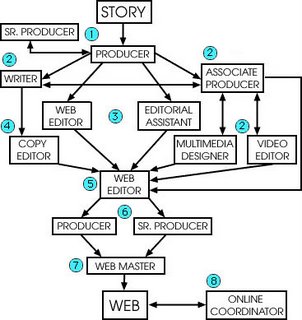


So how it works?

1. After searching through the CNN network-wide news gathering system called Basys, the producer consults with the senior producer to construct a rundown that contains the day's events in order of importance and the coverage planned by the network. Early in his or her shift, the producer holds an editorial meeting to discuss the rundown with the rest of the staff and offer content and presentation suggestions. Three different shifts go through this same process over the course of 24 hours.
Each story is listed on the white board, with the initials of the writer-associate producer team assigned to the story.
2. A writer and an associate producer pick up the story and begin to gather the necessary elements. This is a closely-knit team. The writer sifts through wires, CNN reports and raw video feeds to produce a coherent document that incorporates pictures, sounds, movies and links. The associate producer tracks down the multimedia elements, creates the pictures and sounds, consults the multimedia designer for special graphic requests and discusses QuickTime movie possibilities with the associate producer/video editor. Throughout the process, the writer and associate producer communicate with each other to decide which elements will make the story complete and cohesive.
3. Meanwhile, the web editor scours the Internet for appropriate links and the editorial assistant conducts Lexis-Nexis searches for further background information.
4. Once the story is written, the copy editor takes over to check spelling and style and review factual accuracy.
5. When the story has been copy edited and the elements have been gathered, the associate producer lays out the page on paper, showing where pictures and other multimedia elements should be positioned. This goes to the web editor, who codes the story with HTML so it can be read on the Web.
6. Next, the producer steps back into the picture along with the senior producer. Both check the story for accuracy on an inside server.
7. The nod is given and the Web master double-checks the story for multiple browser support and finally moves it to the outside.
8. If a posted story receives feedback from readers, the online coordinator gathers the feedback and has it posted on the site.
Overseeing the editorial process:
The executive producer handles all of the daily operations of the Web site and offers advice in tough situations.
Crowning the editorial process is the editor in chief, who's responsible for overall editorial vision and direction of the entire department.


So there you go! and as the receipt email from Anderson 360 goes "Anyway, the best we can do is to acknowledge that we have indeed received and will read your message, and this little note is to let you know that. It’s automatic, yes; fails to take into account whether you’ve patted us on the back or slapped us across the face; does not differentiate between praise, correction, fury, proposals of marriage, or invitations to get lost. But rest assured we’ll know that part when we read it! "

You are on notice.

Wednesday, May 16, 2007

Anderson Cooper's Personnel Problems

Anderson Cooper and his show haven't been very lucky in the headhunting department... It is a stressful job, and the correct set of priorities are a must. But it seems that they have switched producers, and the blog is suffering for that.

In this joint post, Newsjunkie and I try to expose what is going on behind the scenes.


Illustrations by Christiane

As has now become painfully obvious, the 360 blog has gone to hell.

Here is our most shared viewpoint on what is likely going on in the back of the CNN newsroom with the moderators:

Betty Ann, our favorite comment woman of all time, has been posting poetry left and right. What is the point of THAT? The other half of her brain (I think there is one in there....) Lori Ann, is disagreeing... apparently with herself. But I’ve already written her next post for her!


Dear Anderson!

I absolutely love your show. You are just DARLING!! Please come on over, We made brownies, and I think we’re brain-dead. I really do. I knew you were talking to us tonight, your eyes were speaking volumes. I just wanted to make sure that this isn’t some type of, like, hallucination that we’re having. Or I could come up to New York, and I’ll bring the recipe for pot brownies with me! Would you like that, sugar pie? I heard the score between you and us is growing! It’s not three to three anymore!

Oh, and I wrote you a poem:

Hello Andy,

My name is Betty Ann

I’m also known as Lori Ann

I’m so crazy

And fat and lazy

I wish you were here to tell my story

I’ve got a bunch of dogs you see

And can make you some pot brownies

So really Andy

Come my way

Come then, and stay

I took my pills for sanity

I’ve got a split personality

You are so cute

And hot and sexy

I’d like to see you

Oh, Andy, please!

~Betty Ann and Lori Ann (it's a satire, ok?)


Apparently “Mark the Moderator” loves Betty Ann and her alter ego Lori Ann- he said so right in the comments! She is apparently his “favorite commenter”...

SO! Let’s have a vote. The CNN 360 blog moderators are:

  • (1) Drunk
  • (2) Stoned
  • (3) Slamming Red Bulls
  • (4) Have their heads up their asses.
  • I’m voting for “all of the above”.

~ Post by Sharla Jones, a.k.a. “newsjunkie”~

- Illustrations By Christiane

Tuesday, May 15, 2007

The Anderson Cooper 360 Blog "official" campaign

The stuff nightmares are made of...

Friday, March 16, 2007

The mysterious Anderson Cooper Blog entry: From snow to Southeast Asia

Maybe it got confused with the Bermuda Triangle and it dissapeared... and
I bet no one checks the right column news tickers or cares... probably I need to get a better use for that column.


Friday, March 16, 2007

From snow to Southeast Asia

New Yorkers awoke this morning to a fresh blanket of snow. It was admittedly somewhat jarring. (Remember when you were a kid and snow was so exciting, at what age does it become annoying?)

I'm heading to Southeast Asia tomorrow morning, so there's always a lot of last minute stuff I have to do, and trudging through the snow just makes it that much harder. I've been getting shots for things I'd never even heard of, who knew you need a vaccine for Japanese Encephalitis? For years I never got shot when I traveled. I figured it wasn't worth the hassle. Considering my cameraman Neil was hospitalized after our recent Brazil trip (he'd been bitten by a spider according to one doctor) and my other cameraman Phil had some bug lay eggs inside him, I've decided to get all the shots I can, and I've promised myself I will actually take my malaria medicine with me this time.

We'll be in Southeast Asia next week broadcasting from a variety of locations. I went to school in Vietnam in the early 1990's but I've only been back to the region once since then. I went for the elections in Cambodia, and I'm looking forward to returning to see how the region has changed. We'll be reporting on environmental issues for our "Planet in Peril" series, but we'll also be looking at sex trafficking, in particular the trafficking of children, which is particularly bad in Cambodia.

We had our morning call earlier today, and there are a number of stories we are following for tonight's broadcast. The morning call is always interesting, folks call in from home or the gym or wherever they are to talk about what's happening today. You can usually hear a couple of kids in the background as producers try to maximize time with their families and get work done at the same time.

Plastered in the middle of our newsroom is this dry-erase board. It's where we lay out the day's show. The words "Ask Believe Receive" are written on the top. I think someone put it up there as a joke when we did a segment on "The Secret." No one's bothered to erase it yet.

Anyway, we were just meeting in front of what we call the "big board." And for now, it's a work in progress. That's okay, it's early. Usually, whatever we put on the board now gets changed later anyway. Still, there are some stories that will definitely make the cut.

One of them is Valerie Plame Wilson. The former CIA operative testified before Congress today and blamed the White House for blowing her cover. But is that true? The Washington Post had put out an editorial several years ago saying, Plame's husband was actually responsible for what happened to her career. I asked him about that a couple of weeks ago and he categorically denied it. We'll look at the facts and find out what exactly she was doing over at the agency.

Jeff Koinange has a fascinating profile about the very strange President of Gambia. This guy has no formal medical training, but he claims he can cure people of AIDS. Actually he claims he can only do it on certain days of the week. He says the treatment came to him in a dream.

From there, things get really bizarre. It's a really interesting story, the kind you won't see anywhere else.

That's it for now. I'm off to take another look at the big board.

Ask. Believe Receive. Sure, why not?

Posted By Anderson Cooper: 2:32 PM ET
0 Comments | Add a Comment

Friday, January 05, 2007

As requested... have fun!

Monday, November 27, 2006

Anderson Cooper Blogs from Turkey

Pope's Turkey trip spotlights religious tensions

Tonight we are broadcasting from Istanbul, one stop on Pope Benedict XVI's visit to Turkey. Istanbul is a fascinating place, a city where East and West meet, literally. It's the only major city that sits on two continents. One side is in Europe, the other side Asia.

I'm sitting in a modern hotel right now listening to the call to prayer echoing from a nearby mosque. The oldest cliche in the news business is to call a place a "land of contrasts." It's a silly term, but I understand why writers fall back on it to describe this place. Ancient and modern, Islamic and Christian, democratic and autocratic -- it all exists side by side in Turkey, sometimes uneasily.

Though its track record on human rights is often criticized, Turkey is a stable, pro-western democracy that is officially secular. For some time now, the country has been trying to become part of the European Union, but it seems increasingly clear that some European countries have major concerns. Turkey is a poor nation by European standards, and it's 99 percent Muslim. Many Europeans are already concerned about assimilating their own Muslim minorities. The prospect of having some 70 million more Muslims entering the EU seems overwhelming.

Before he was Pope, then-Cardinal Ratzinger didn't support Turkey's bid for EU membership. His argument was that Europe is based on commonly held Christian beliefs, not simply geography. Combined with his recent comments about Islam, it would be easy to see why many here would be concerned about his visit. But what is actually surprising is how few people here seem disturbed by the Pope's presence.

An Islamist party called for a demonstration in Istanbul on Sunday. They expected more than 100,000 protestors, but only about 20,000 showed up. There are some extremists here to be sure. I just spent the morning with an Islamist lawyer who is defending a number of Turks accused of participating in a series of terrorist attacks in 2003 that killed more than 50 people.

As we were putting the microphone on him, I couldn't help but notice the gun he was carrying on his waist. During the interview, he called Osama bin Laden a freedom fighter and explained why suicide attacks were justified under his brand of Islam.

He and the men he represents hate the secular government of Turkey. They say the current prime minister was put in power by an alliance between the Pope and Israel, or maybe it was the Pope, Israel, and America -- I can't remember for sure (I'll have to check the tape) but you get the point.

His beliefs do not reflect the majority of Muslims in Turkey, but they do explain some of the tensions that exist here. The question is: What will the Pope try to do during his visit? Will he try to mend fences, and focus on the commonalities between Islam and Christianity, or will he respectfully talk about the differences? While many people here don't seem all that interested in his visit, they will be watching and listening closely.

What do you think the Pope should focus on while in Turkey? I'm curious to hear your thoughts.

Posted By Anderson Cooper: 10:09 AM ET

Thursday, October 05, 2006

This is not a fairy tale, by Anderson Cooper

This is not a fairy tale
by Anderson Cooper

There are some things you see, some things you hear that simply are unspeakable. In a hospital in the eastern Congo city of Goma, we met a little girl. She never said a word to us, she could barely look us in the eyes. When she did, her eyes told the story.

"She never says anything to men," one of the hospital counselors explained, and then she told us why.

The little girl was raped. Gang-raped. It was allegedly done by soldiers engaged in a complicated regional war that has claimed millions of lives. The war officially ended in 2003, but outbreaks of violence and rape continue. The girl is now five years old. She was raped when she was three.

I wish I could tell you this was an extraordinary event. I wish I could tell you she was the only child attacked. The hospital was full of rape victims, and the doctor had seen other small children victimized.

Because the rapes are so violent, women often develop fistulas -- ruptures in their vaginas or rectums that make it impossible to control bodily functions. A charity called Heal Africa was running this hospital, and the doctor said he was able to fix about 70-80 percent of the fistula cases, but of course some wounds never heal.

Heal Africa has opened up a residence for women with fistulas that can't be surgically fixed, at least not here in the Democratic Republic of the Congo. The women can't go home. Often they've been rejected by their husbands because they were raped. The stigma here is strong.

I met a woman named Angela. I can't stop thinking about her. She was raped by three men in front of her children. Afterwards they shot her, and she says they burned her baby girl. The girl is four now and has a massive scar all over her chest.

Angela's fistula was fixed, but her arm remains injured from the gunshot. Pscyhologically she's still devastated. To make matters worse, her husband kicked her out of the house.

"He heard I was raped," she said whispering. "And he just said, 'Go on your own, I don't need you anymore. If we lived together, you now might have HIV so you might infect me.'"

I didn't ask Angela her HIV status. I didn't think it was any of my business. Perhaps I should have asked, but she didn't volunteer it, and I felt like I'd already asked her too much.

The funding for the Heal Africa house comes from an NGO, but their funding ends in April. It's not clear what will happen then.

"The only thing I need is some land so I can build a house," Angela said to me before I left. "I might die and I want my kids to have that castle. I'm hoping for a miracle."

There aren't many miracles in the Democratic Republic of the Congo. This is not a fairy tale, some stories don't have happy endings. Here the men who rape with impunity are rarely brought to justice. Women like Angela are expected to simply bear the pain.

If you would like to help Heal Africa in the work they are doing, you can log onto their website

Friday, September 29, 2006

Dying in Silence

Photobucket - Video and Image Hosting
Map of the Congo from the CIA World Factbook.

Friday, September 29, 2006

Dying in silence

We are on our way to central Africa. Right now we're in Dubai waiting for one of several connecting flights we'll be taking to get to the Congo.It's a place many Americans know little about, and yet each of us carries a piece of the Congo with us, wherever we go. Minerals mined in the Congo like tin ore and coltan are essential components in cell phones, computers, and video game consoles.

The battle over who gets to mine those minerals has fueled the deadliest conflict the world has seen since World War II. More than three million people have died in the Congo since 1998 and there has been very little coverage of it. Tens of thousands of women have been raped; often gang raped by soldiers and militia members. What has happened there is hard to fathom, and still some 1200 people are dying every day from malnutrition and disease.

It is ironic of course, that in our hi-tech world, the very place that makes our phones and computers work, is one of the least developed and impoverished places on the planet. Next week we will be doing something I don't think any other network has ever done. We will be covering two major humanitarian crises at once, the Congo and Darfur. Jeff Koinange and Dr. Sanjay Gupta will be reporting on Darfur and I will be in eastern Congo.

Logistically this is an incredibly difficult undertaking. It's expensive, and requires a huge team of people. The truth is no one but CNN would undertake a mission like this. Our plan is to take all of you along on this journey, to two places you have rarely seen. So many people in the Congo and Sudan have already lost their lives; so many more lives hang in the balance. There are few things worse than dying in silence, too many already have. I hope you'll join us on this trip.

Posted By Anderson Cooper: 4:04 PM ET

--from the AC 360 blog

Go here to read a blog that features news about the Congo.

Thursday, September 28, 2006

Anderson Cooper didn't read my comments, but one of the 15 people employed to do so did!


Many seek and comment at the Anderson Cooper's blog at the CNN page expecting to have at least a cyber connection with the gray haired anchor. In reality, if he read all the comments he wouldn't have a career nor a life. Instead of Anderson, all comments are filtered by an army of 15 content editors employed at CNN solely to monitor comments on his blog.

Mark Chernesky, Web Development Director for Digital Media Technologies, Turner Broadcasting System, gives us an inside look of how the cyber version of CNN works.

"It is not magic. Type in the URL -- cnn.com -- and all the day's news suddenly appears on the screen before you. Just like our on-air sister, frequent updates and breaking news bulletins provide readers with up-to-the minute coverage of world events.

But in this speed of light medium, getting a story onto the Web is a bit more complicated than the simple push of a button. The article passes through no fewer than 10 people. Follow the chart below as the story evolves from a news event to a full-blown in-depth interactive report, where the reader, order the news by priority and decide which elements of a story are most important"


So how it works?

1. After searching through the CNN network-wide news gathering system called Basys, the producer consults with the senior producer to construct a rundown that contains the day's events in order of importance and the coverage planned by the network. Early in his or her shift, the producer holds an editorial meeting to discuss the rundown with the rest of the staff and offer content and presentation suggestions. Three different shifts go through this same process over the course of 24 hours.
Each story is listed on the white board, with the initials of the writer-associate producer team assigned to the story.
2. A writer and an associate producer pick up the story and begin to gather the necessary elements. This is a closely-knit team. The writer sifts through wires, CNN reports and raw video feeds to produce a coherent document that incorporates pictures, sounds, movies and links. The associate producer tracks down the multimedia elements, creates the pictures and sounds, consults the multimedia designer for special graphic requests and discusses QuickTime movie possibilities with the associate producer/video editor. Throughout the process, the writer and associate producer communicate with each other to decide which elements will make the story complete and cohesive.
3. Meanwhile, the web editor scours the Internet for appropriate links and the editorial assistant conducts Lexis-Nexis searches for further background information.
4. Once the story is written, the copy editor takes over to check spelling and style and review factual accuracy.
5. When the story has been copy edited and the elements have been gathered, the associate producer lays out the page on paper, showing where pictures and other multimedia elements should be positioned. This goes to the web editor, who codes the story with HTML so it can be read on the Web.
6. Next, the producer steps back into the picture along with the senior producer. Both check the story for accuracy on an inside server.
7. The nod is given and the Web master double-checks the story for multiple browser support and finally moves it to the outside.
8. If a posted story receives feedback from readers, the online coordinator gathers the feedback and has it posted on the site.
Overseeing the editorial process:
The executive producer handles all of the daily operations of the Web site and offers advice in tough situations.
Crowning the editorial process is the editor in chief, who's responsible for overall editorial vision and direction of the entire department.


So there you go! and as the receipt email from Anderson 360 goes "Anyway, the best we can do is to acknowledge that we have indeed received and will read your message, and this little note is to let you know that. It’s automatic, yes; fails to take into account whether you’ve patted us on the back or slapped us across the face; does not differentiate between praise, correction, fury, proposals of marriage, or invitations to get lost. But rest assured we’ll know that part when we read it! "

You are on notice.

Sunday, September 24, 2006

"360°" asks why so many Muslims around the world say they hate Americans. Can their minds be changed? "

You asked: "360°" asks why so many Muslims around the world say they hate Americans. Can their minds be changed? " When people forget and ignore their history they are condemned to repeat it...The answer for your question would be Respect and Tolerance. I live in a country that was invaded by the USA a century ago, the american authorities unilaterally intended to impose the use of the English language to a country who have been using Spanish for 400 years, unilaterally - again - changed our national anthem and up to the 1980s to display the national flag was proscribed and it was a reason enough to be persuted and killed. We also served as guinny pigs for the studies for the development of "The Pill" tricking women to consume them thinking it was vitamins, others were simply sterilized without their consent, ( Joseph Mengele comes to mind, but his american version was Dr. Cornelius Rhoads who in written opinions stated the Puerto Rican population should be eradicated). The Infamous "Orange Agent Chemical" was test tried over our population and our rain forest. To live near military bases like Roosevelt Roads granted you the dubious right to have your daughters, mothers and sisters harrased or raped by marines, sometimes in their days off they could just get drunk and have hit and runs killing entire families and hiding behind the military bases where they were immune to local authorities. The latest assault attempt: how the Federal Prosecutor Office is intending to over rule OUR CONSTITUTION forcing the death penalty. And the list goes on and on, race included. You will see this pattern again and again in all of the countries that have lived this experiences with the USA and other invading countries as Albert Memmi presents in his book Portrait of the Colonizer. If we transport this experience to the Middle East, we see a super power like the USA - through its Executive Branch - with a xenophobic discourse against muslims, their millenium way of life and culture, it is no longer only against Al Qaeda or specific terrorist groups. It is an overly offensive to every muslim in the world. For a country as young as the USA, who still struggles with its own cultural definition, many countries find extreamly arrogant their intention to impose "their way of life" that unfortunately translates to the interest and needs of USA based corporations and multunationals. We just have to see the dramatic political changes in LatinAmerica to understand it. After the attacks in Madrid (11/3) the spaniards and its new government ( the misleading of information and Aznar's support to the war in Iraq was key to the overturn) took a novell approach, first they recognized the influence of the muslim and islamic culture to its own. Their history has been linked through centuries. Then in order to control the illegal immigration mostly from the north of Africa, they created incentives for corporations to establish fair business practices in those countries in order to promote their local econmomy and development that they hope will translate into less illegal migration. The entire world is very eceptic of the USA. We see it as a country of contadictions, a world police with a thin glass roof. Were people are educated through the entertainment industry and video games. Where it is more newsworthy if someone kidnaps Paris Hilton dog, Tinkerbell, beat it to death and it will make frontlines. Cut to the Mexico - USA border and try to make a story of an illeagal that got killed while trying to enter the USA and no one will care. Probably you will have cheerleaders cheering those who commited the crime. You know there is something wrong with a society when Humane Rights go over Human Rights.My mother always told me that arrogance is based on ignorance. I think history lessons are in order.
Posted by Christiane Amanpour Wednesday, September 13, 2006

MANIFESTO

Don't think for me. Don't assume what I want to hear or read. Give me facts. Give me reasons. But not yours. Bring me debate. Enlighten me. Today, accountability is masked behind anonymity; bylines are hidden by zeros and ones. Everyone publishes; everyone is "in the know." Ethics are non-existent. Speculation is king. The truth is masked and a hostage. Empowered by our minds, WE ARE THE FREAKSPEAKERS!

FAIR USE NOTICE

This site contains copyrighted material, the use of which has not always been specifically authorized by the copyright owner. We are making such material available in our efforts to advance understanding of issues of environmental, political, news and humanitarian significance. We believe this constitutes a "fair use" of any such material as provided in section 107 of the US Copyright Law. In accordance with the title 17 U.S.C. Section 107, the material on this blog is distributed and available without profit to those who have expressed a prior interest in receiving the included information for research and educational purposes.

If your obsession against us and our content endures, you might find more information at: Law.

If you wish to use copyrighted material from this site for purposes of your own that go beyond "fair use", you must obtain permission from the blog owner.
