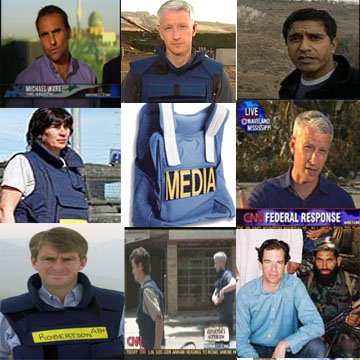
Showing posts with label Anderson Cooper. Show all posts

Friday, January 09, 2009

Times UK - Proving the use of White Phosphorus

While Anderson Cooper is very busy enjoying the buzz and coverage of his Puppy Debate, the Times-UK finally exposed the IDF and its use of White Phosphorus

It's sooo easy to cover govermental gathered schells without asking the same government about this kind of weapons - which happen to be ILLEGAL to use agaisnt civilians -. If they could now find the cluster bombs with depleted uranium.


From The Times
January 8, 2009
Gaza victims' burns increase concern over phosphorus

The pale blue 155mm rounds are clearly marked with the designation M825A1, an American-made white phosphorus munition

Michael Evans, Defence Editor and Sheera Frenkel in Jerusalem


Photographic evidence has emerged that proves that Israel has been using controversial white phosphorus shells during its offensive in Gaza, despite official denials by the Israel Defence Forces.
There is also evidence that the rounds have injured Palestinian civilians, causing severe burns. The use of white phosphorus against civilians is prohibited under international law.
The Times has identified stockpiles of white phosphorus (WP) shells from high-resolution images taken of Israel Defence Forces (IDF) artillery units on the Israeli-Gaza border this week. The pale blue 155mm rounds are clearly marked with the designation M825A1, an American-made WP munition. The shell is an improved version with a more limited dispersion of the phosphorus, which ignites on contact with oxygen, and is being used by the Israeli gunners to create a smoke screen on the ground.
The rounds, which explode into a shower of burning white streaks, were first identified by The Times at the weekend when they were fired over Gaza at the start of Israel's ground offensive. Artillery experts said that the Israeli troops would be in trouble if they were banned from using WP because it is the simplest way of creating smoke to protect them from enemy fire.
There were indications last night that Palestinian civilians have been injured by the bombs, which burn intensely. Hassan Khalass, a doctor at al-Shifa hospital in Gaza City, told The Times that he had been dealing with patients who he suspected had been burnt by white phosphorus. Muhammad Azayzeh, 28, an emergency medical technician in the city, said: “The burns are very unusual. They don't look like burns we have normally seen. They are third-level burns that we can't seem to control.”
Victims with embedded WP particles in their flesh have to have the affected areas flushed with water. Particles that cannot be removed with tweezers are covered with a saline-soaked dressing.
Nafez Abu Shaban, the head of the burns unit at al-Shifa hospital, said: “I am not familiar with phosphorus but many of the patients wounded in the past weeks have strange burns. They are very deep and not like burns we used to see.”
When The Times reported on Monday that the Israeli troops appeared to be firing WP shells to create a thick smoke camouflage for units advancing into Gaza, an IDF spokesman denied the use of phosphorus and said that Israel was using only the weapons that were allowed under international law.
Rows of the pale blue M825A1 WP shells were photographed on January 4 on the Israeli side of the Israel-Gaza border. Another picture showed the same munitions stacked up behind an Israeli self-propelled howitzer.
Confronted with the latest evidence, an IDF spokeswoman insisted that the M825A1 shell was not a WP type. “This is what we call a quiet shell - it is empty, it has no explosives and no white phosphorus. There is nothing inside it,” she said.
“We shoot it to mark the target before we launch a real shell. We launch two or three of the quiet shells which are empty so that the real shells will be accurate. It's not for killing people,” she said.
Asked what shell was being used to create the smokescreen effect seen so clearly on television images, she said: “We're using what other armies use and we're not using any weapons that are banned under international law.”
Neil Gibson, technical adviser to Jane's Missiles and Rockets, insisted that the M825A1 was a WP round. “The M825A1 is an improved model. The WP does not fill the shell but is impregnated into 116 felt wedges which, once dispersed [by a high-explosive charge], start to burn within four to five seconds. They then burn for five to ten minutes. The smoke screen produced is extremely effective,” he said.
The shell is not defined as an incendiary weapon by the Third Protocol to the Convention on Conventional Weapons because its principal use is to produce smoke to protect troops. However, Marc Galasco, of Human Rights Watch, said: “Recognising the significant incidental incendiary effect that white phosphorus creates, there is great concern that Israel is failing to take all feasible steps to avoid civilian loss of life and property by using WP in densely populated urban areas. This concern is amplified given the technique evidenced in media photographs of air-bursting WP projectiles at relatively low levels, seemingly to maximise its incendiary effect.”
He added, however, that Human Rights Watch had no evidence that Israel was using incendiaries as weapons.
British and American artillery units have stocks of white phosphorus munitions but they are banned as anti-personnel weapons. “These munitions are not unlawful as their purpose is to provide obscuration and not cause injury by burning,” a Ministry of Defence source said.
Mads Gilbert, a Norwegian war surgery specialist working in Gaza, told The Times that he had seen injuries believed to have resulted from Israel's use of a new “dense inert metal explosive” that caused “extreme explosions”. He said: “Those inside the perimeter of this weapon's power zone will be torn completely apart. We have seen numerous amputations that we suspect have been caused by this.”


Copyright 2008 Times Newspapers Ltd.

Wednesday, January 07, 2009

Debunking the Spin: not an easy thing to do for Anderson Cooper and CNN

It´s a fact: Israel won´t allow jounalists into Gaza.

What CNN and Anderson Cooper says in his own blog:

¨The problem is that in not allowing international journalists into Gaza, Israel is guaranteeing that the only pictures from the Palestinian side are the ones Hamas wants the world to see. Press control by Hamas is heavy-handed. Hamas controls who reports from there and where they can go. While pictures of wounded children being brought to hospital are clearly encouraged, we rarely see images of Hamas fighters, or their rockets being fired into Israel.¨

Playing along or being the spin doctor? That is such a desconstructed and cheap way of diminishing the work of other journalists. I always thought that THE New York Times, Associated Press, Reuters, and AFP were serious media outlets. Many journalists know those are the places to be in order to gain respectability - not celebrity - as a journalist. Contrary to CNN they have bureaus within GAZA, sent or contracted journalists in the West Bank. People who have to live the hard task - just like the CNN people in Iraq - of living in a war zone. Far from the commodities of a 5 star hotel near the IDF headquarters where the press releases and summited videos are hand delivered.

Another thing that Cooper descunstruct is the FACT that wire services publish a lot of content, and the photo editors and desk editors purchase the images and stories THEY want to publish according to their editorial line. To say: ¨we rarely see images of Hamas fighters, or their rockets being fired into Israel ", well.. google and yahoo news are your friends. Blame the media outlets not the news services that are working their bids.

From AP Masked Palestinian militants from Islamic Jihad run with homemade rockets to put in place before later firing them into Israel on the outskirts of Gaza City, Saturday, Dec. 20, 2008. (AP Photo/Ashraf Amra)


Masked Palestinian militants from Islamic Jihad place homemade rockets before later firing them into Israel on the outskirts of Gaza City, Saturday, Dec. 20, 2008. (AP Photo/Ashraf Amra)


Why is Anderson Cooper and CNN even suggesting that NYT´s TAGHREED EL-KHODARY or others are mouth pieces for Hamas? I know its a competitive business, and it must suck for them to have a reporter from a newspaper or wire service giving first hand accounts. Witnessing the destruction, but targeting your peers and doubting their accounts calling all the media controlled mouth pieces? Or is just because they are not westerners? Islamofobia?

What is the difference? CNN is giving plenty of air time to the Israeli govenment and only presenting what the Israelis what them to present. Who is doing the spin? Who is the mouthpiece? Even his reports about the damage from the Hamas rockets can´t compare to the ones done by CLUSTER BOMBS and WHITE,PHOSPORUS. Why CNN US won´t even mention the fact - denounced by the UN as reported by the BBC- that the IDF is known for using illegal weapons? Don´t talk about the consequenses of their use and the danger they become after the battle engagement ends?
Anderson Cooper´s report , Lethal Rockets, is almost a copycat of the one he did during the Lebanon-Israel conflict. Anderson Cooper and team showing their range...

Then he stated: “We'd come to get a look at the damage and had hoped to talk with a Hezbollah representative. Instead, we found ourselves with other foreign reporters taken on a guided tour by Hezbollah. Young men on motor scooters followed our every movement. They only allowed us to videotape certain streets, certain buildings. Once, when they thought we'd videotaped them, they asked us to erase the tape. These men are called al-Shabab, Hezbollah volunteers who are the organization's eyes and ears.”

Doesn´t that have an eerie similarity of what Israel is allowing how and what to report today? When we see reporters in Israel running like sheeps towards the site where a rocket has landed? Why haven´t they interviewed moderate Israelis that are strongly opposing the conflict WITHIN Israel. CNN´s silence for access? Islamofobia?
Anderson, just grant me a wish... can you please do a story - think about equal time - about the cluster bombs? ehh I know... nevermind.

Today AP distributed this report. Worth Reading.
AP Gaza reporter finds hometown in rubble

By IBRAHIM BARZAK, Associated Press Writer Ibrahim Barzak, Associated Press Writer

GAZA CITY, Gaza Strip – I live alone in my office. My wife and two young children moved in with her father after our apartment was shattered. The neighborhood mosque, where I have prayed since I was a child, had its roof blown off. All the government buildings on my beat have been obliterated.
After days of Israeli shelling, the city and life I have known no longer exist.
Gaza City, with some 400,000 people, stopped supplying water when the fuel ran out for the power station driving the pumps. We listen to battery-run radios for news, even though the outside world watches what's happening to us on television. Grocery stores are closed and food is scarce.
Hospital officials say more than 600 Palestinians have been killed in Israel's military operation to crush Hamas, the radical Islamic movement that rules Gaza. Many are civilians.
Three days after Israel began its airstrikes on Gaza on Dec. 27, my apartment building was shaken by bombs aimed at a nearby Hamas-run government compound.
My brother took a picture of the room where my boys, 2-year-old Hikmet and 6-month-old Ahmed, once slept. Their toys were broken, shrapnel had punched through the closet and the bedroom wall had collapsed. I don't know if we will ever go back.
The Israeli army issued a video of the bombing of the Hamas compound, which it posted on YouTube. I can see my home being destroyed, and I watch it obsessively.
On Tuesday, I stood outside my apartment building but didn't dare to enter. I was worried the remains of the nearby Hamas compound might again be shelled without warning.
Driving back to central Gaza City, I took the road where Gaza's two main universities are. It was covered with shards of glass, telephone cables, electricity wires and flattened cars. This road was once crowded with students, taxis and street vendors. It was always noisy and jammed.
The only shop I found open was a pharmacy run by my friend Eyad Sayegh. He's an Orthodox Christian, and I stopped to wish him a Merry Christmas — Eastern churches celebrate Christmas on Jan. 7.
Eyad told me he forgot it was Christmas.
All the landmark buildings I covered as a reporter have vanished.
The colonial-era Seraya was the main security compound for the succession of Gaza's rulers — the British, Egyptians, Israelis, the Palestinian Authority and then the rival Palestinians of Hamas.
We used to fear the Seraya, where the central jail was. Now it's rubble.
Of the presidential office overlooking the sea only a few walls remain. For many Gazans it was a symbol of our statehood, even though President Mahmoud Abbas, who also heads the Fatah movement, hasn't been there since Hamas seized control of the territory in June 2007.
Someone planted a Palestinian flag on the building's remains. The huge gate at the western entrance still stands, giving an illusion of something big behind it.
And across the city, the Parliament house is half destroyed.
On Jala Street, one of Gaza's main roads, I saw about 30 boys around a leaky irrigation tap on a traffic island. They were clutching empty soft drink bottles and jerry cans, trying to fill them with water.
Samir, who is 9, told me his family has no water at home and he wanted to bring enough for a bath because he and his brother smell.
So do most people in Gaza right now.
In my father-in-law's building, residents throw out bags of spoiled food. With no power, refrigerators don't run and fresh food quickly rots.
Shortages are getting worse, leading to unusual gender equality in the bread lines. I saw about 150 men and women gathered to buy bread — but standing in separate lines. The men complained the women, normally so deferential to men, kept pushing, so now they have two lines.
There are few cars on the roads, and most of those are media cars, ambulances and vehicles packed with civilians. Some look like they are fleeing, with mattresses tied to the roofs, but who knows where they can go.
Israeli helicopters fly overhead. I hear blasts in the distance. The roads have been ripped apart by explosives.
I drive into downtown Gaza, trying to prove to myself I can still do something I have done so often before — drive through my city.
I reach the Catholic school I attended, where my late father used to bring me every day. The building is undamaged. I stand in front of it, wondering if I will ever walk my children to this school.
PEACE!

Monday, January 05, 2009

Breaking the Silence on Gaza and Anderson Cooper

I´m torn with the idea of Anderson Cooper covering the conflict. Penhaul and the CNN international crew has done such an extraordinary job. Reporting with no BS, nor official spins.
I can already make the rundown of his coverage.

1. Anderson is going to be as partial and bias as with the Lebannon war becoming the mouth piece of the Israeli Government.


2. Anderson will focus and focus and focus about the Hamas Rockets and will Ignore, Ignore and IGNORE the Cluster Bombs with uranium and the White Phosphorus gas that is being used by the IDF - which by the way are illegal -.


Caption: It landed right here

Anderson Cooper examines the damage in an Israeli marketplace where a rocket launched by Hamas landed.

How he compare that with THESE?


3. Will Anderson Cooper call the thousands of harmed and hundreds of death - particularly children - part of the Hamas proganda staging?


4. Will he even bother interview one of his supposed favorite charities Doctors Without Borders about how they can't reach Gaza?
5. Sure there will be a 3 minute "Reporters Notebook" of how innocent animals - like dogs and cats - are being used as shields by Hamas ( I'm being way cynical here!! but actually a Boston newspaper just did it! ) or how humane Israel is towards the wounded pets injured by Hamas rockets ... it made me sick!


Over a year ago The Jerusalem Post published a letter from Mordechai Eliyahu to Olmet -in which he states: "If they don't stop after we kill 100, then we must kill a thousand," "And if they do not stop after 1,000 then we must kill 10,000. If they still don't stop we must kill 100,000, even a million. Whatever it takes to make them stop."

The core of the issue was presented by the israeli general Moshe Dayan: "The declaration of the State of Israel in 1948 was at the expense of ethnically cleansing 513 Palestinian villages, creating over 700,000 Palestinian refugees and expropriating their lands, homes and businesses in 78% of Palestine … There is not one single place built in this country that did not have a former (Palestinian) population."

I doubt that Anderson Cooper might present the crisis in a balanced context. I doubt that he won't even be capable of not inserting himself in the story, making it as always, all about him and the photo ops. In this time of economic crisis and massive lay offs - including CNN -, he should have stayed in NY and just read the teleprompter and save the travel expenses. There are better and more capable reporters from CNN already in the area.
This is a time of No spin, No bias, No bull.

Monday, April 07, 2008

more R&K

Those of you who can't watch morning shows on weekdays, I hope you enjoy watching Anderson co-hosting Regis and Kelly last week. I join others in wishing Anderson complete and fast recovery.

part1


part2


part3


part4


part5

Saturday, February 02, 2008

What's cooking, Anderson?

To the joy of political junkies like me, CNN plans two more debates at the end of February if nominees will not be determined by then. No word so far if Anderson will host one of them. Can't say I enjoyed Anderson's moderating of this week's debate, but I enjoyed him co-hosting Regis and Kelly yesterday. Interesting that ABC's leading news anchor Charlie Gibson was Kelly's guest just a day before. If you missed Anderson's appearance, watch it right here!

part1


part2


part3


part4


part5

Tuesday, October 23, 2007

Anderson on Regis and Kelly

Anderson Cooper was a guest on "Live with Regis and Kelly". Jimmy Kimmel is co-hosting this whole week, so it was interesting to see Anderson as a guest. Enjoy!

Sunday, October 21, 2007

Focus on Africa

Anderson Cooper had a new report from Niger on 60 minutes, he went there to see how things have changed after his Emmy-winning report in 2005. It's great to see that 60 minutes allows him to report on issues that matter and that he has passion for, not limiting him to celebrity interviews. Anybody who missed it --watch it here!


UPDATE: Anderson is going to Congo next weekend on assignment for 60 Minutes

Thursday, September 13, 2007

1 hour with Anderson Cooper

Now all speculations might rest, Anderson Cooper 360 was officially downsized to 1 hour, the 11 slot will be filled with...... A REPEAT!!! geez no one saw that coming.....

CNN turns '360' into hourlong
Cabler makes tweaks to Cooper show

Anderson Copper
Cooper

Anderson Cooper is about to do a 180.

CNN is permanently shifting to taped programming for the second hour of "Anderson Cooper 360," scaling back an ambitious programming block created in 2005 to showcase the studio and field-reporting talents of Cooper, who it viewed as an emerging star.

CNN launched Cooper in the two-hour live block starting at 10 p.m. ET in the aftermath of Hurricane Katrina two years ago, placing him alongside Aaron Brown, whose "NewsNight" had been extended an additional hour to report on the disaster.

But CNN soon benched Brown and made the two-hour block permanent, with Cooper at the helm, and promoted the anchor's blend of reporting with personality that became his signature.

CNN's cable news competitors air taped programming at 11 p.m. ET, a cheaper proposition, and the second hour of "360" runs second in the ratings to a rerun of "The O'Reilly Factor" on Fox News Channel.

Cooper averaged 747,000 viewers in his second hour in August, less than O'Reilly's 965,000 and a steep drop from the 1.1 million he averaged during the first hour, according to Nielsen.

Sources at competing networks have long speculated that CNN would cancel the second hour and revert to tape at 11 p.m.

CNN spokesperson Christa Robinson said the net has no intention of canceling the second hour and cast the move as a continuation of what the network had been doing this summer--reverting to pre-recorded programming in the second hour unless news events warrant otherwise.

But insiders say the net has been weighing a return to a repeat of "Lou Dobbs Tonight," or as some suggest, airing a repeat of Campbell Brown's new show which will be launched in November.

When CNN extended "NewsNight" in 2005, it displaced a second airing of "Lou Dobbs Tonight," a lucrative hour for the net since it cost nothing to produce, raked in advertising and exposed Dobbs to West Coast viewers at 8 p.m.

The move was seen at the time as a blow to Dobbs, though his numbers have grown since then and the firebrand anchor's hour is now CNN's highest-rated show behind "Larry King Live."

Sources said both Dobbs and Brown have lobbied for the time slot.

The stakes are high for Brown, who is set to compete at the 8 p.m. hour against FNC's O'Reilly and MSNBC's Keith Olbermann. If she gets another airing at 11, she'd face O'Reilly twice a day.

MSNBC at one time experimented with Tucker Carlson at 11 p.m. but soon moved him to 6 and launched its "Doc Block," filled with repurposed "Dateline" episodes.

Wednesday, August 29, 2007

Where did Anderson Cooper go?

When Katrina hit the US Gulf Coast, Anderson Cooper was catapulted from second tier anchor to a mainstream name. The Landrieu interview (above) became the “voice” of the Nation’s indignity in the way things were handled by the Bush and State administrations. Some claimed that precise moment was the turning point of Cooper’s career; others went so far to claim he was the new face of journalism, or the birth of the emo-anchor. The rebirth of journalism. Or was it?

Cooper became a symbol, the ultimate resource of everything Katrina, almost a spokesperson for the victims coining the phrase Keeping them Honest. The public was tired of the silence of the press, of its fear (the press and parent companies) of losing access to information if they made the right questions about Iraq, their contractors or any sign of corruption to the White House. Cooper’s interview to Landrieu broke that silence. And its force was comparable to Katrina.

Time Warner and its research division didn’t miss the opportunity to grasp the reaction. Bad news is good news for media outlets. They gain a lot of money with tragedies. And they were going to milk the Cooper empathy for what it was worth. Soon he was everywhere: billboards, ads, magazine covers, book tours. He was presented as a new millennium super hero. Every interview meticulously scripted and threaded (just think about the interviews that he repeats the same information over and over again). CNN’s promotional budget for him was rumored to be around 10 million. And the public loved it. But Scholars and media professionals on the other hand weren’t so pleased.

Was the Landrieu interview a constructed effort or an outburst of raw emotion and indignation? Most (scholars and professionals) think it was a very decent human been calling on someone on its own Bull Shit, but not a journalistic endeavor. Some claim he became the face of Katrina, sometimes focusing everything on his image eclipsing the real issues and problems.

He tried to keep the bravado in other interviews like the one with Iran’s president. Mahmoud Ahmadinejad, which was very close to a train wreck where he went to the cheap offensive and righteous position of claiming freedom of press, forgetting that his own executive producer asked at the 360 blog ( Sept. 20, 2006 ) to submit questions to the president, making valid Ahmadinejad’s question about if he asked everything ”they asked him to ask”. He missed a golden opportunity to provoke questions, discussions; he went with the cheap smart ass trick.

His reports and series became photo ops for promotion, some of them like the Planet in Peril editions a great example of bad production. Many people were looking forward to his Katrina first anniversary special, which ironically became the perfect example of mediocrity. They didn’t even used the reports made by the team of American Morning (excellent BTW) They limited themselves to the old shrimp boat… to later claim there is no right to have Katrina Fatigue.

All the promotional investment hasn’t proportionally translated in strong and steady ratings growths. Seven years ago, during an Edwards R. Murrow Awards Ceremony at the RTNDA, Christiane Amanpour presented and excellent explanation to it: “I believe good journalism is good business.” And the monster ratings she had with God’s Warriors proved it, leaving in the dust all news stations.

But it’s not all Anderson Cooper’s fault. TV production is a team effort. Management and production has to work hand in hand, and respect its audience, something that the team behind Cooper is seriously lacking or forgetting. Sometimes I ask myself if we are really watching CNN or E!?

Amanpour again addressed the issues:

“Surely a news operation should be the crown jewel of any corporation…the thing that makes a corporation feel good about itself. We all love "Millionaire," make your money off that….make your super-dollars somewhere else. Leave us alone, with only good competitive journalism as our benchmark. I know I do not need to remind you of all the quality programs that make money too…60-minutes, Nightline…are just a couple. No matter what the hocus-pocus focus groups tell you, time has proven that all the gimmicks and cheap journalism can only carry you so far.”

“Remember the movie "Field of Dreams" when the voice said, "Build it and they will come." Well, tell a compelling story and they will watch. Lest you think these are woolly-headed musings …we are not dinosaurs…we are the frontier. You've mastered the hardware…we are the software. And that will never change. Today's buzzwords seem to be content, and platforms. Well, we produce the content for all your different platforms…and that will never change. Humble newsprint, the New York Times, still rules the world. As someone else might have said, "It's the content stupid." You've invested so much money in technology…perhaps it's time to invest in talent…in people…do you know how many people in newsrooms I know have a hard time even recognizing news anymore….”

People in the media knows that CNN is great for entry level positions (the pay isn’t that good unlike networks), but unfortunately the lack of experience of its productions slaps you through your TV set. A friend from Argentina who usually catches 360 through CNN International sent me an email furious about the coverage of the Vick case. He couldn’t understand how that case was more important than the lost of entire cities in Peru or other international events. Why people in Europe should tune in to watch CNN for Paris Hilton? As Anderson Cooper once said: there is a war, there is a war, there is a war. And God’s Warrior proved that people tune in for good content.

Tonight Anderson will present his Katrina Second Anniversary Special. I no longer expect to be amazed or informed by his show. I do not even expect to see quality. I’m tired of the endless rehashing and recycling of news or clips that belong to America’s Funniest Videos or Animal Planet, an insult when you think there are hundreds of journalist that are killed in order to cover the news, and a whole nation hungry (or at least in need) to be informed in an entire new perspective.

Will tonight mark the return of Anderson Cooper? I'm not holding my breath.

Monday, August 27, 2007

Back to Blogging

Happy Monday everyone,
another week, another adventure or another dull routine... August have been very hectic to say it softly. I really want to thank Courtney and Ivy for keeping things running in my absence, I didn't expected it to be so long, and although I had the opportunity to sneak into the chat, blogging was an overkill for me.

This week The FreakSpeakers blog celebrates its first anniversary. A year already! Many thought we wouldn't last this long, and sincerely after all the controversies I'm even surprised of our endurance. We have had great moments, some thunderstorms and hurricanes... but we are still standing and having fun in the process.

For our chat regulars and lurkers, we changed the chatroom platform. It is a lot more friendly and it is supposed to work better... follow the link and check it out! (remember @10 PM) With this platform we have a lot more control.

I also want to present you with a comment made by Ted Casablanca at his Awful Truth Column, which I found disturbingly funny:

Anderson Cooper, just wanna warn ya: The boys in Manhattan’s David Barton gym are on a mission, I’ve been informed, to sidle up to you at the urinals every time you go for a little relief, in case you hadn’t noticed, which, I’m certain, is an impossibility. Take it as a compliment, you little CNN cutie! Last time I heard there was such a package-peeking explosion in New Yawk, it was aimed at the hunk who may rest in peace, JFK Jr. So, take the compliment already, babe.

Is there a scavenger hunt for a pic of Anderson Cooper's private parts? I see another gym in Anderson's near future...

And to enhance your morning, and as usual, here some photos of Anderson!

I'm off to get some coffee!

Friday, August 03, 2007

Anderson Cooper on The View

For our international viewers and those who missed Anderson Cooper on The View.


Thursday, August 02, 2007

Anderson Cooper on Jay Leno

For our readers who couldn't see Anderson on Jay Leno show.


Sunday, July 22, 2007

Anderson Cooper Interviews

Seems that Anderson has another anderfan with Morra.. here we are posting two excellent recent interviews with Anderson Cooper.


Fifteen minutes with Anderson Cooper, and your questions

By Morra Aarons, 6:03 am, Sat 21 Jul 2007

My fifteen minutes with Cooper left me buzzing. I wanted to go live in Anderson-world. It’s rare you’re in the presence of someone really imbued with the purpose of their work, but that’s how I felt after our talk. It made me want to work harder. Cooper is someone admits he works “all the time,” but what I emerged with from our brief interview was a sense of the importance of passion and social justice. (Ed note: the funny thing about CNN is that in the midst of its obsession with Paris Hilton and horses that fall off trails, and bland morning anchors, it maintains room for some iconoclasts, like Cooper and Lou Dobbs). And it’s ironic, because my primary experience of watching presidential candidates discourse has been one of numbness, process, talking points. So when Cooper told me the purpose of this new debate format is to “infuse questions with a new spirit and energy,” I believed him. I want to thank BlogHer readers for providing such good questions and helping to create a natural discussion.

I’ve summed up our discussions below, using quotes sparingly because I did not have a recorder and I don’t want to misquote. If I misconstrue, I apologize. In our brief discussions, three themes emerged:

CNN/YouTubeThe Importance of “Bottom Up” Media

Anderson’s take on the YouTube debate is that it’s an unknown quantity for both the network and the candidates. Unlike most presidential debates or forums, in which a moderator or panel of journalists pose questions to the candidates, on Monday night YouTube is the panel, and voter generated content provides question materials. (To watch some or submit your own, click here). CNN’s Washington Bureau Chief David Bohrman said on air yesterday that there might be some tougher questions that challenge the candidates- implying other debates didn’t? I asked Anderson if that was true.

He said the thing that he thinks will be challenging is that not only are these questions a traditional moderator might not ask, but that the questions twist and turn. “You…think it’s going one way, then it turns around.” He noted candidates will have to listen to the whole stream, and not spout poll-tested talking points (well, at least not the whole time). He said he was struck by the quality of the questions and the diversity of those posing them (although early reports showed very few women submitted questions, he said he noted a strong diversity…I’m not buying it, but ok).

I then asked, is one of the goals of this debate to take candidates out of their comfort zone? Cooper said the major goal- - is to show a different side of candidates, and yes, to take people out of comfort zone. He said he thought the campaigns seemed “nervous…we’re all little nervous.” The debate should infused with “the spirit and energy of questions, the spirit of the voters’ questions should “infuse and inform entire debate.” Thankfully, Anderson admitted he didn’t know what this “infusion” actually meant, but I think I do.

I hope the debate echoes at least part of what we see online everyday, at BlogHer and on other sites: true discussions, questions off-book, questions that are the product of real curiosity.

Feely snarky, I asked Anderson if he wanted a seminal, “Boxers vs. briefs” pull quote to come from the CNN/YouTube debate Monday night.

He bristled and said, no, “it’s more serious than that…it’s a real bottom up process…” CNN is not “cherry picking” the questions they think are most appropriate. They’re going to pool the best ones and see what happens. He hopes it’s more of a “conversation.” And that he will facilitate dialogue by ensuring when a candidate responds, you can redirect the question to another.

I hope this isn’t the end of the feedback loop. If CNN wants to create a real conversation, they need to offer viewers a place to retort. Anderson did mention that many of the campaigns are preparing videos- but I think the YouTube channel devoted to discussion of the debate—CitizenTube—should have a stronger role and a more publicized “retorting” ability for voters.

CNN/YouTube
Responsibility

The best thing about talking to Cooper was his complete sense of responsibility and respect for both his interview subjects and his audience. I asked him my favorite question, which was from our NGO and Social Change editor Britt Bravo:

She asked: how does he beat burn out and compassion fatigue? (Christiane's note: that is something I always wonder)

He took a minute to think. He said burnout is tougher, because his “tendency is to work all the time, work on weekends and vacation days for 60 minutes, with no time off. Echoing a sentiment many of us feel, he said if he does take a week off, he feels “torn.” Echoing a sentiment very few of us feel, he also added that invariably, if he takes time off “something happens.” Global crises have no respect for beach time, I guess.

Anderson did say that the best way to fight against burnout is to do a variety of different things, and to feel different things. This way, work feels fresh. Also, you need to try to keep a balance, to hang out with your dog and your friends and recharge. Amen. (Christiane's note: to those obsessed with Molly, she seems to be around...)

Cooper stated that if you suffer compassion fatigue, it’s a “copout.” If nothing really affects you, but you’re asking people to let you into their lives, you’re doing them disservice, and you’re doing your audience a disservice.

He noted: “When I was 23 and first started and spent 2 years in war zones…I found that my reactions [were] not what they should have been…” In Rwanda, during the genocide, he could no longer react in a "sensible" way. So, he “took a break from combat stuff for a year…and then started doing it again.” You owe it to those whose stories you tell, and to your audience to feel. Still, I cannot imagine that Katrina did not take a chunk out of his psyche. Or perhaps, it gave him an all new energy.

CNN/YouTubeNew Journalism

Next, I asked Anderson some of your questions about journalism, YouTube, and fame.

First I asked JoAnn’s question: since he has become famous, are there any types of reports that he finds more difficult to cover than when he was an unknown reporter? If so, how does he handle these differently now than he did in the past?

Anderson laughed and said, he deludes himself that he’s not famous. This helps him interact normally with people, because the celebrity makes him uncomfortable. But he acknowledged, it “cuts both ways- it helps to have people know you” if you’re in a war zone and you need to get on a chopper…you’ll get greater access.
Anderson did stress that being a journalist, for him, is being a blank slate. One must adapt to any situation, because you’re “telling a story…it’s all about the story.” It’s funny, because being a blogger is the opposite: good bloggers are anything but blank slates. They bring it ALL to the page (or screen, as it were).

To that end, I asked Anderson the second half of JoAnn’s question: he has suggested that he sees the future of news leaning towards the YouTube generation- and does he see a tension between old media and new?
He stressed that citizen journalists and professional journalists don’t battle against each other, and that it’s important to tell the story from as many angles as possible.

He said obviously there wasn’t YouTube 17 years ago when he started, but if there were, he would have probably taken that path, creating his own videos on YouTube.

That said, “there is something to be said for research, fact checking, standards of what they put on the air…a lot to be said for that. Getting it right does count.” It’s important to know where information is coming from. And yeah, people write stuff of the web, people believe it…some of it is completely off the wall stuff. ( Christiane's note: have he been reading the Freakspeaker Manifesto?)

In short, there’s a role for mainstream media, and it’s not a battle for supremacy. I don’t think any but the most obstreperous blogger would disagree with this.

Then I asked him about Paris Hilton. I asked Stacy’s question: Hello. I'm interested in how much control Anderson himself has over what goes into his broadcasts. For example, it was clear he was unhappy covering Paris Hilton, so was that something he felt he had to do to compete with the other networks, or something he was made to do by the suits?

Anderson said he has control over what goes on the air ( Christiane's note: so Anderson is the one to be blamed?) , and that since his job is “to tell stories…you are able to spend time on the one that matter to you.” He was just in Congo, Iraq, Afghanistan. The show covers Iraq (which Anderson noted is the “most important” story now) every night, which some other networks (ed: hello, Fox News) don’t even mention. Anderson said, you have to consider what people want to see, but if you do a show based on what people want to see, "you end up with nothing but true crime stories.”

He noted it’s a privilege to be in peoples’ living rooms...but there are lots of folks he’s competing against, so yeah, when Paris got out of jail and did Larry King... “if there were any two days to cover it, those were them.”
We closed by talking about the role of the Internet and politics in 2008. I asked him the million dollar question that everyone seems to ask: ok fine, we know the web can raise money for candidates, and it drives message, but can it get people to vote?

Anderson said he didn’t know. He said the big question for him is, “are people using it to reach just folks who would have gone to polls anyway”? We agreed no one knows the answer to this.

He continued, “What’s so interesting about time we’re living in is that nobody knows what’s next. He told me about how he makes sure he goes to a tech media conference once a year to keep up to date. Four years ago he went to fancy, Silicon Valley genius conference and no one predicted the impact of online video. We have “no idea what’s coming down the pike. Who knows? Who knows what kind of hand held device will be in people’s living rooms [four years from now]”?

Final question, from the audience: Will he try his hand at writing fiction?

He laughed and said “I don’t think I’m that good a writer to do that…I marvel at writers’ ability to tell stories and weave narratives.” Still, it’s clear Cooper is a storyteller, but a visual one.

Unlike many skeptics online, I’m looking forward to this debate. I think it signals a shift, a maturing of both voter generated content, and acknowledgement that online political participation is simply an extension of the ancient tradition of the forum, the commons, and the town hall meeting. Stay tuned for coverage Monday night. Like Anderson and, I'd wager, Hillary Clinton, I’m a little nervous!

Anderson Cooper Hopes Monday's Debate Throws Candidates out of Their Comfort Zones

By Steven Edwards EmailJuly 22, 2007 | 7:30:34 PMCategories: Politics

Anderson_cooper Anderson Cooper and I spoke on Wednesday about Monday's Democratic CNN/YouTube debate in Charleston, SC. I asked him a variety of questions, including how the questions will be selected and whether the politicians may need to go drinking after the debate format, where the candidates won't have any idea what questions are coming.

A little delayed, but the interview has lots of valuable information about how the debate will play out. Will the range of questions be narrowly focused on science and technology as opposed to other broadly focused debates?

Read and find out.

Wired News: I want to welcome Anderson Cooper, host of Anderson Cooper 360 on CNN and also the moderator for the CNN/YouTube debate from the Citadel in Charleston, SC on Monday, July 23rd. How are you doing today?

Anderson Cooper: I'm good. Thanks for having me.

WN: Thanks for accepting the offer.

I was wondering, first of all, what percentage of the questions will come from YouTube? Will you ask them, or will they come from YouTube?

AC: Well, all the questions are coming from YouTube. I'll have the ability to ask follow-on questions based on topics raised by the YouTube videos, but I think the vast majority of the questions put to the candidates will come from YouTube.

We're trying to figure out ways to incorporate as many videos as possible -- not just in the original questions, but even in follow-up questions. Traditionally in debates there's the question you ask a candidate and then there's follow-up questions you ask based on that topic. We're hoping to incorporate other YouTube videos in those follow-on questions to maximize the number of questions that get asked by YouTube viewers.

WN: That sounds prety good. Are you going to have a variety of "What If" scenarios planned, that way you have a number of videos selected for whatever their answer is?

AC: Absolutely. A lot of this will be done on the fly, depending on where the conversation goes. Debates in general are best when there's an actual conversation -- when people are actually talking about substance, answering questions, and there's a real conversation going rather than just individuals giving stump speeches or talking points.

There's no way to predict exactly where it's going to go, so we want to have videos on as many different topics as possible on hand that we can call on, depending on where the conversation goes.

WN: Senators Clinton and Edwards recently got in trouble for suggesting that the current debate formats prevent candidates from giving substantive answers to questions. Given that the candidates agree on broad policies -- such as universal health care -- will the debates be run in a way that allows candidates to give more specific answers? i.e., "You all agree that x, y, and z need to be done, but what differentiates you on these issues?"

AC: I certainly think that would be a big hope for the debate. You definitely don't need to have everyone just agreeing on the stage on issues where they do happen to agree. I think you do -- in the questions that the YouTube users are asking -- you want to try to get to the specifics as quickly as possible.

WN: Are you going to, maybe, discriminate against questions where they mostly agree on policies?

AC: Not necessarily. If there's a great question or a great YouTube video that maybe is a little too broad, I might try to narrow it down a little bit in a follow-on question.

As much as possible, this is a bottom-up process as opposed to a top-down process. This is not just me and a few other people randomly selecting videos and then asking the questions that we want to ask anyway. We're taking our directions from the YouTube users and the CNN watchers -- the people that made the videos -- and are, as much as possible, honoring and promoting the videos themselves -- the questions that the people in the videos are asking.

I see my job as being there on behalf of all those who can't be there, but are there on video who are asking their questions. My job is just to make sure people get answers -- real answers -- to their questions.

WN: So you're facilitating the discussion between the American public and the politicians?

AC: Yeah. That's certainly the job.

WN: A lot of the debates thus far are very broad-based, topic-wise, with everything on the table. Is the CNN/YouTube debate intended to be similarly broadly-focused, or will the topics discussed be narrower in focus -- or does the American public get to decide?

AC: They're deciding. They're deciding based on whatever questions they put in. We're taking our marching orders from the videos themselves, and those videos are online now -- anyone can watch them.

Someone asked me the other day, "This is at the Citadel. Are you going to be heavy on military questions?"

The answer is no. We're taking our marching orders from YouTube viewers and from CNN watchers -- the people who are actually asking the questions -- and we're getting a broad range of topics. Some really interesting, insightful questions -- some really surprising questions -- and we want those to come to the fore.

WN: How will the submitted questions be picked? Will it be based on views? Popularity?

AC: No. There's a handful of people at CNN who will decide -- I'm one of them -- which videos will make it into the debate. Some of that will be done on the fly. We'll whittle it down to a reasonable number that we have on hand, and depending on the ebb and flow of the debate -- depending where the conversation goes -- we'll decide which videos to use.

A lot of this is going to be done right before the debate. People can submit videos until July 22nd, and we want a video that was submitted on July 22nd to have as much chance as a video that was submitted a month ago.

There's no final list already. I've seen most of the videos at least once; there's maybe a few right now I haven't seen, but for the most part I've seen them and we're all sorta putting suggestions in a virtual hat. We'll whittle it down to a number that is manageable and take it from there.

WN: Which candidates do you think will fare best in the CNN/YouTube debate?

AC: I have no idea. What I think is interesting about this is that I don't think the candidates have much of an idea, either. They're not really sure what to expect. I'm not really sure what to expect, and I think that's a good think. I think it should be interesting.

WN: Do you have any topics that you would like to hear discussed, or hope get discussed during the debate?

AC: I hope -- no, I don't have an agenda going into this that I want to hear x, y, and z. I think it would be a mistake and inappropriate if we got all these remarkable videos and then decide that we're just going to do the topics that we want to do.

I view this as I'm taking my marching orders from the YouTube viewers, and I'm honoring their topics and right now we're seeing a wide variety of topics.

WN: I wasn't suggesting that you have an agenda going into this, I was just wondering if you might have some personal interests that you hope gets asked.

AC: No, I don't. I hope that YouTube viewers and CNN viewers come away with this feeling that this is something different and that they have seen something different.

I was a little nervous about it at first because I wasn't sure just how it would all work; I had a hard time envisioning it. But once I started watching the videos, I absolutely understood how it would work, because I think there's something very compelling in these videos.

There's a cumulative effect to them that is really interesting. Watching all of them as a piece, it's just different than any... I've never seen anything like it in a debate, and it'll be interesting to see how it all flows together.

WN: Will there be any commercials in the debate?

AC: There will be. There will be a very limited number of commercial interruptions. I'm not sure how many breaks there are -- I think two or three -- but I'm not sure.

WN: I was just trying to figure out how long the debate schedule would last.

AC: Yeah, I don't know how long the commercial breaks would be that are there. My guess is that they won't be that long, because I know they want to keep that very limited.

WN: Would you mind answering why y'all chose Charleston, just out of curiosity?

AC: You know, it's a good question, and I don't know the answer to that. I'm not sure how that was determined. That process was decided before I got involved.

WN: Will the video of the debate be available on CNN or YouTube after it is aired?

AC: CNN would certainly repeat it later that evening, and I'm assuming that -- everything's available on YouTube -- so I'm assuming it would be ironic if this wasn't available on YouTube.

I'm assuming it will be. I haven't talked to the YouTube folks, but most things end up being broken down into chunks on YouTube, so I'm assuming the same thing would happen.

I know YouTube has a whole online component that they'll have a lot of debate reaction online to it, so yeah, I'm assuming you'll be able to watch chunks of it. I'm not sure how YouTube will be presenting that.

WN: I know a lot of companies, like Viacom, when their videos go online they get pretty mad and demand that they be taken down. I was wondering if CNN is going to allow them to be posted online.

AC: There's tons of CNN stuff on YouTube, so I think it would be a bizarre situation if this was the only thing that could not be on YouTube. I'm sure it'll be on YouTube.

WN: What do you hope happens after the debate? The candidates, do you hope that they have a broader understanding of what the American public really want, instead of them giving out their sound bites like they normally do?

AC: Yeah, frankly I hope that they're out of their comfort zone.

I think the most important thing is that they have to really pay attention to these questions, because some of them are tricky and some of them are unexpected and not what you think. The question seems to be going one way and then all of a sudden the end, another question is asked.

I certainly hope the candidates listen carefully and I hope that they get into the spirit of it. I really do think that there is something different about this debate, and about these questions. I hope that comes across in the broadcast, and I hope that comes across in the answers. I hope the candidates honor the passion that we're seeing in the videos.

WN: If the candidates give a dodge or a non-answer to a question, will you follow-up and ask them to really answer the question?

AC: Absolutely. I think that's my number one job. We have a lot of people here who have taken time to put together a question, and the least the candidates can do is answer those questions.

I'm not talking about giving a response, because -- as we all know -- politicians can give a response very quickly, but an answer is different than a response and my job is to make sure they answer.

WN: That would be good. I did read a few non-answer responses in the headlines recently.

AC: Sure.

WN: Your next debate will be in, I'm not sure where. For Republicans.

AC: Yeah, it hasn't been determined yet. It hasn't been announced yet. It will be somewhere in Florida.

WN: Are you hoping that -- well, not hoping -- but do you think that Republican candidates will have a better shot at knowing what they may be coming into?

AC: I'm sure there are going to be a lot of people in the Republican campaigns watching on Monday night. Yeah, they'll have the benefit of at least having seen it. I think that, I'm sure there will be some surprises, but they will have seen one of these before.

WN: Do you think the Democratic candidates have staff looking through the questions to prepare stock answers?

AC: I'm sure they do, but there's 1400 of them right now. They have no idea what's going to be selected. I don't think any of them have campaigns right now which are big enough to be pouring through on that level of detail.

WN: Do you think they'll all go get margaritas afterward?

AC: I'm not sure. We'll see. I'm not sure what's available, what'll be open late at that hour.

WN: Or maybe take some anxiety pills before and after?

AC: Exactly. Perhaps. Hopefully they'll take them afterward, because we don't want them all bushed out on anxiety pills.

WN: Well, you now, it might be interesting for some candidates.

AC: That's true. You're right.

WN: Besides having the candidates unnerved, what do you hope this debate accomplishes? You touched on it briefly earlier, but what do you hope the candidates take away from this?

AC: I think one of the unique things about YouTube in general -- and I think it carries over to the debate -- on YouTube, you see sides of people, and often public people that you don't necessarily normally see in tightly scripted television appearances.

That cuts both ways. You can see candidates making terrible gaffes and saying things they regret on YouTube, but you also see people showing sides of themselves they haven't already seen. I hope we see that in this debate as well. I think it's an opportunity for candidates to really interact in a way with people that they may not be able to interact with on the campaign trail.

It's only in Iowa and New Hampshire that people really get to interact with candidates on a sort of a personal level and really spend time and see candidates on a personal level. This is a democratization of the process to some degree, and I hope that this debate is a chance for candidates to show that other side of themselves and to have sort of a genuine interaction even though it's online interaction.

WN: Do you think some candidates will see, "Oh, I might need to think of a policy position on this topic that I didn't know was really important before"?

AC: It's possible. I think most of the topics they have certainly thought through -- I think there's some that they may be surprised by. I think it's always good to see people confronted with a variety of issues, and issues that they haven't been confronted with by voters in the primary states that they've been. So, yeah, I think it is an opportunity for education both for viewers and also for candidates.

WN: I know the final questions have not been selected yet, but will the questions you select be focused on actual issues or will you select YouTube questions that ask about their personalities and not so much their policies?

AC: Yeah, I think you want a variety of stuff. I think you want things which are interesting and that provoke discussion and/or provoke reaction which tell viewers something, and I think you want a variety of things. Again, that just all depends on the videos.

WN: It would be interesting to see the candidates answer a bunch of really random questions. Zune or iPod? Mac or Windows?

AC: Yeah -- I was just looking through a note I had and South Carolina was picked by the Democratic Party.

WN: Probably because we have an early primary for once.

AC: Yeah.

WN: I noticed that a number of questions were submitted by politicians inside the state of South Carolina. Will non-politicians or non-professionals have priority over politicians?

AC: No one has any priority over anyone else in terms of the selection of questions. If I understand your question correctly, you're saying politicians have submitted questions?

WN: Yes. Some politicians in South Carolina have submitted questions and I was wondering if they...

AC: Oh no, they have no priority over anybody else. They have as good or as little a chance of having their question selected as anybody else. There's no secret channel of questions that come to us at CNN.

I can tell you, literally, I have spent the last couple of days just sitting in a room with a handful of producers and literally have the YouTube home page up on a big screen and we're just clicking and looking at each video. There's no secret pool of questions that we're getting somehow funneled to us.

If there's a politician asking a question, and they haven't identified themselves as a politician, we wouldn't know who they are unless we happen to know who they are. A famous person has just as much chance of having their question selected as someone who's not famous, or a school teacher has just as much a chance as a politician somewhere.

WN: I was wondering not that they may get priority over non-politicians or non-famous people, but moreso if the non-famous people and the non-politicians would get priority over politicians and famous people?

AC: No one has any priority over anybody. It's an even playing field. It's based solely on the merit of the 30-second question.

WN: I think I've pretty much exhausted my questions. I appreciate your time and I hope to see you in Charleston.

AC: All right, cool. Take care. It was good talking to you.

Are you ready for the debate? Anderson Cooper and CNN seems to be

CNN's Anderson Cooper, right, leaves the set as he prepared for an afternoon rehearsal with Citadel cadets standing in for the candidates on Sunday, July 22, 2007, in Charleston, S.C. The Citadel's McAlister Fieldhouse is being transformed into a huge stage for the Democratic presidential candidates debate on Monday. (AP Photo/The Post and Courier, Wade Spees)

A friend just emailed me to let me know that his youtube question was selected for the debate.


We will be moderating the chat from 7 pm... see ya all there!

Does he ever rest?

YouTube, CNN change debate rules

By Paul J. Gough
CHARLESTON, S.C. -- In this sunny, sultry setting bursting with Southern military tradition, CNN and YouTube hope they'll break ground on a new tradition in televised political debates.

It's here at the Citadel, the 165-year-old South Carolina military academy, where the two media companies will test, with the help of the Democratic Party, a new wrinkle on the admittedly tired old debate format. Tonight's two-hour broadcast will feature all eight declared Democratic candidates answering no questions from the 2,000-member audience gathered at the McAlister Field House; instead, they'll look to a 25-foot video screen at 30-second clips recorded by YouTube users young, old and interested in the future of the country.

The debate could help alter the traditional format and give computer-literate ordinary citizens and the new media a bigger role in political discourse.

"It's the beginning of everybody figuring out what the role of new media is in the election process," said David Bohrman, CNN's Washington bureau chief and the executive producer of the debate. It's Bohrman's job to assemble the CNN campaign set, clear the technological hurdles of having made-for-Web video and audio translate into TV and, with a team of CNN staffers and moderator Anderson Cooper, decide which questions will make it to air.

"Literally anyone, anywhere has a chance to ask a question," Bohrman said. "They're unlike any questions posed to presidential candidates before."

A glance at YouTube, where the nearly 2,000 videos have been collected since June, proves it. The questions range from such serious topics as education, health care, global warming and energy policy to the kind of offbeat, humorous clips that YouTube is famous for. One pair from Tennessee, Jackie and Dunlap from RedStateUpdate.com, challenge Sens. John Edwards and Barack Obama to take off their shirts to see who is more buff.

"Some of them are funny, some of them are incredibly serious. Some have shot on location, some have used props, historical footage," said Cooper, who will moderate the debate. "It's much different than a town hall (format) where someone stands up and has prepared questions where they recite the question. These are very intimate, and very personal in some cases. They're very effective."

Most of the videos aren't directed to any one candidate, which will make it easy for Cooper to direct questions to the candidates of his choice.

The structure of the debate will be driven by the video questions, which will spark so-called modules of up to five minutes where Cooper can follow up and other candidates can talk. Bohrman sees a fairly smooth discussion compared to other debates that he says can have a herky-jerky feel.

"All of the candidates should get the same number of questions, or close to it, and we'll work hard to balance that out," he said. "There will be a trigger question, a discussion starter, from the YouTube videos, and Anderson will have a five-minute window to bring other candidates into the discussion."

Cooper, who earlier in his career worked with Rock the Vote, said the candidates and viewers should expect the unexpected.

"I think no one really knows exactly what to expect, and that's what is going to make it interesting," Cooper said. "Even if the questions have been asked before, they are being asked in a different way."

Said Larry Sabato, a professor of politics at the University of Virginia: "It's a significant leap forward because it's utilizing one of the newest technologies for the first time. We haven't used YouTube before (for a debate). We've used e-mail, we've used other forms of citizens' participation, but YouTube is all the rage."

Sabato believes that this form of video participation will bring in young people who are disaffected from the debate process.

The technical challenge of converting Web video and audio to a format that can look good -- and be understandable -- on TV has weighed heavily on YouTube and CNN for a while. Bohrman said that none of the questions will be altered or edited, though some of the technically challenged ones could get a boost in audio.

Perhaps an even bigger challenge will be to the eight candidates themselves. They could conceivably see all or most of the videotaped questions beforehand -- all they have to do is watch hundreds of hours on YouTube -- but they won't know which questions CNN will pick. And CNN isn't telling.

Waring Howe Jr., chair of the Charleston County Democratic Party, thinks this will give viewers at home a chance to see the real candidates, not packaged sound bites.

"How does one prepare for a debate of this kind? You can't -- and I think that's the beauty of it," Howe said. "There's no way to prepare, no way to obfuscate."

Bohrman agrees and hopes that it will be a lot like the candidates do in the low-tech, one-on-one gatherings in the early primary/caucus states of New Hampshire and Iowa, often in private homes.

"I hope the candidates answer them on the same direct and personal level and don't go into posturing and position statements, which is what they do when they answer a journalist's questions," Bohrman said. "It'll be really interesting to see how the candidates react. The candidates are understandably a little bit out of their comfort zone."

On Friday, CNN's staff was busy assembling the set and getting ready for airtime at 7 p.m. EDT Monday. They're using the set that CNN had at the New Hampshire debate in June, which with modifications here and there will be the one the network uses for each of the 10 events it will sponsor during primary season. There are modifications, like the personal video screens on each candidate's podium that will allow them to see the video questions without having to look up at the 25-by-18-foot screen that will show the video as well as the questioner's name and hometown. But Bohrman said Friday that with one successful setup at St. Anselm's College already under its belt, the crew should have no trouble finishing the job by the end of the day. Rehearsals with Cooper were scheduled Saturday and Sunday, in between making the final cuts for the 30-40 videos that will be presented during the two-hour telecast.

The CNN staff, who will be selecting the videos without the input of YouTube, has been busy sifting through the submissions. Bohrman, who said he's seen all of them at least once and many of the best a dozen times, has been packing in time on YouTube every chance he gets. On Friday, he excused himself to watch even more of the submissions that were still coming in.

CNN and YouTube also are helping to give Charleston, a colonial-era seaport steeped in history and the military, a chance to spotlight the center of the Low Country. CBS' "The Early Show" originated live from Charleston on Friday, focusing on the city's culture and history. The national media descended on Charleston during the weekend and, even when the Democrats leave, will remain to cover President Bush's speech at the Charleston Air Force Base on Tuesday. That's all good for Mayor Joe Riley, who has led the city since 1975.

"You can't cover a debate in Charleston without covering Charleston," he said.

This is the first of two scheduled debate collaborations between YouTube and CNN. They'll produce a similar event with the Republican candidates in September in Florida.

"We consider this in a real way the first seed of a potato," CNN's Bohrman said. "I'd love to see a version of this debate in the general presidential campaign."

Sabato doesn't know if the YouTube video participation will stay forever, but he thinks a version of it could catch on.

"It will be part of the future" Sabato said. "I don't think we'll ever again have a debate in the traditional format with a moderator and two panelists. That is boring, and it's one reason why so few people watch debates, beyond the presidential debates."

Friday, July 20, 2007

Anderson Cooper on diapers, bibs and another f!"#/&°°! Ann!

Anderson diaper bag, Erica and Cooper bibs? Anderson asks Erica if her husband was jealous -) in What Were They Thinking segment...


And if we didn't have enough Anns already, Anderson introduces us to another bitch...


Oh! and this is just disturbing!

Wednesday, July 11, 2007

Is Anderson dancing with Murdoch or just being polite?

Hi everyone!
I've been under the weather lately, and my brains are less than functional lately... but here a sobering image of the Allen & Co. party in Idaho which was attended by top media executives and where Allen would be presenting their new WIFI and technology trends...which right now is the back bone of the communications industry.


News Corp. CEO Rupert Murdoch (L) talks to CNN's Anderson Cooper during lunch at the Allen and Co. conference at the Sun Valley Resort in Sun Valley, Idaho July 11, 2007. REUTERS/Rick Wilking (UNITED STATES)

If you are interested in a day by day account of the event visit the NYTimes Deal Blog

Thursday, July 05, 2007

Anderson in peril or is he missing his blue shirt?

Oh the tales of the blue shirt! How many complains we have read about it, some call it the filthy stinky and sometimes even Anderson's security blanket. Sure he can afford more shirts, but maybe it's his lucky one. Anderson must be missing it... particularly what it represents: FIELD REPORTING! Get out of the studio Anderson!

When we started the FreakSpeakers project we wanted to focus on the behind the scenes and the perils of being a journalist. It has been awhile since we last blogged about the topic but for the newbies we will be repeating some of the post of our archives ( hey if Anderson Cooper and CNN repeats to the 9th degree why can't we? It's summer!). This post was first published October 15, 2006 and since then our community and readers have increased significantly.

Why the Blue Shirt and other concerns


Minimizing Risks in Conflict Zones

Comportment
How journalists conduct themselves in the field may help save their lives, and the unwritten rules can vary from conflict to conflict. In some situations, for example, it may make sense for journalists to have a high profile, while in others, drawing attention to yourself may draw a hostile reaction from combatants. Talking with seasoned reporters who have covered the region is essential; veteran correspondents are usually generous with advice to newcomers.
Clothing and Culture
Journalists should be mindful of the kind and color of clothes they wear in war zones. Members of the media should always place prominent labels on their clothing (including helmets) that clearly identify them as press. Journalists who accompany armed combatants—irrespective of whether the combatants are uniformed— must consider how their own clothes may look from a distance. Bright and light colors that reflect a lot of sunlight may make a journalist too conspicuous. But wearing camouflage or military green could make journalists targets. Depending on the terrain, dark blue or dark brown may be preferable. In particular, some photojournalists prefer black because it doesn’t reflect light, but some combatants, especially rebel forces, often wear black. Of course, journalists should also respect local sensibilities. This includes men and women dressing as decorum may require. Foreign journalists of both sexes should also be aware of practices that could be offensive in some cultures.
Weapons
Journalists covering conflicts should never carry arms or travel with other journalists who carry weapons. Doing so jeopardizes a journalist’s status as a neutral observer and can make combatants view correspondents as legitimate military targets. In some particularly dangerous conflicts, journalists have hired armed guards. The practice first became widespread among television crews and reporters covering Somalia in the early 1990s after journalists traveling without armed guards were robbed at gunpoint. Journalists who use armed guards, however, should recognize that they may be jeopardizing their status as neutral observers. For example, CNN crews used armed guards in northern Iraq in 2003. On one occasion, unidentified attackers shot CNN’s vehicle, which was clearly marked with “Press,” and CNN’s hired guard returned fire. The gunmen continued to shoot the vehicle as it turned around and drove away. CNN International president, Chris Cramer, defended the network’s use of armed guards as necessary to protect CNN personnel in Iraq. Robert Menard, secretary- general of the Paris-based press freedom watchdog group Reporters sans FrontiĆØres, however, criticized CNN, saying that the practice “risks endangering all other reporters.” Many broadcasters now regularly employ experts from private security firms to accompany their news crews in the field, but these experts are not armed and primarily provide guidance on movements in conflict areas, including large street demonstrations.
Participatory Behavior
For their own protection, journalists should not engage in participatory behavior on the battlefield, such as identifying enemy locations, and they must be mindful at all times of their behavior, language, and attitude toward combatants. Whether they are embedded with military forces or traveling independently, the only role that journalists should play on the battlefield is that of observer. All journalists must remember that participatory behavior while traveling with combatants—or anywhere within a conflict area— an put them and their colleagues in danger.

MANIFESTO

Don't think for me. Don't assume what I want to hear or read. Give me facts. Give me reasons. But not yours. Bring me debate. Enlighten me. Today, accountability is masked behind anonymity; bylines are hidden by zeros and ones. Everyone publishes; everyone is "in the know." Ethics are non-existent. Speculation is king. The truth is masked and a hostage. Empowered by our minds, WE ARE THE FREAKSPEAKERS!

FAIR USE NOTICE

This site contains copyrighted material, the use of which has not always been specifically authorized by the copyright owner. We are making such material available in our efforts to advance understanding of issues of environmental, political, news and humanitarian significance. We believe this constitutes a "fair use" of any such material as provided in section 107 of the US Copyright Law. In accordance with the title 17 U.S.C. Section 107, the material on this blog is distributed and available without profit to those who have expressed a prior interest in receiving the included information for research and educational purposes.

If your obsession against us and our content endures, you might find more information at: Law.

If you wish to use copyrighted material from this site for purposes of your own that go beyond "fair use", you must obtain permission from the blog owner.