Showing posts with label Iraq. Show all posts

Thursday, August 16, 2007

Do we need a draft?

For those who missed LKL and AC360 the last 2 days, here's a part of Bill Maher interview with Larry King where they talk about Iraq and draft, and the other clip is Michael Ware on Anderson Cooper 360 explaining situation in Iraq after yesterday's deadly suicide bombing that claimed over 500 lives.


You might have read that a few days ago Lt. Gen. Douglas Lute, known as "the War Czar" told NPR that military draft is considered. "I think it makes sense to certainly consider it, and I can tell you, this has always been an option on the table, but ultimately, this is a policy matter between meeting the demands for the nation's security by one means or another."

Tuesday, January 16, 2007

Thinking of Michael Ware

It is going to be near two months since the last time we saw Michael on air. I hope he is well, healthy and in the company of his loved ones. God knows he deserves a long vacation. It is not easy to live and work in hell. In his last live transmission from Baghdad he looked wired, tired, stressed. He must have the worst working hours ever. Work all day and stay awake for the Satellite... a 9 hour difference? Personally I don't know. But he must be tired. Things in Iraq are far from being resolved. I don't know if he is going back, CNN have several reporters there after all, and the amount of journalists killed over there is simply alarming. For me it is extreamly sad to see how people get all hyped, obsessed with pity dumb stories while people literally die in order to gain access to the truth. Maybe it is just America.

From the people from the Committee to Protect Journalists:


New York, December 20, 2006—Violence in Iraq claimed the lives of 32 journalists in 2006, the deadliest year for the press in a single country that the Committee to Protect Journalists has ever recorded. In most cases, such as the killing of Atwar Bahjat, one of the best-known television reporters in the Arab world, insurgents specifically targeted journalists to be murdered, CPJ found in a new analysis.

Worldwide, CPJ found 55 journalists were killed in direct connection to their work in 2006, and it is investigating another 27 deaths to determine whether they were work-related. Detailed accounts of each case are posted on CPJ’s Web site. The figures reflect increases from 2005, when 47 journalists were killed in direct relation to their work, while 17 others died in circumstances in which the link to their profession was not clear. CPJ, founded in 1981, compiles and analyzes journalist deaths each year.

Afghanistan and the Philippines, with three deaths apiece, were the next most dangerous datelines in 2006. Russia, Mexico, Pakistan, and Colombia each saw two journalists killed. All are traditionally dangerous countries for the press, CPJ research shows.

But for the fourth consecutive year, Iraq was in a category all its own as the deadliest place for journalists. This year’s killings bring to 92 the number of journalists who have died in Iraq since the U.S.-led invasion of March 2003. In addition, 37 media support workers—interpreters, drivers, fixers, and office workers—have been killed since the war began.

Only four journalists died in Iraq in 2006 as a result of crossfire or acts of war, CPJ’s analysis found. The other 28 were murdered, half of them threatened beforehand. Three were kidnapped and then slain, CPJ found.

“The deaths in Iraq this year reflect the utter deterioration in reporters’ traditional status as neutral observers in wartime,” said CPJ Executive Director Joel Simon. “When this conflict began more than three and half years ago, most journalists died in combat-related incidents. Now, insurgents routinely target journalists for perceived affiliations—political, sectarian, or Western. This is an extraordinarily alarming trend because along with the terrible loss of life, it is limiting news reporting in Iraq—and, in turn, our own understanding of a vital story.”

The viciousness of the onslaught in Iraq was shown on October 12 when masked gunmen attacked the Baghdad offices of the fledgling satellite TV channel Al-Shaabiya and executed 11 people, five of them journalists. It was the deadliest single assault on the press since the 2003 invasion.

Here are other trends about Iraq that emerged in CPJ’s analysis:

• Thirty of 32 journalists killed were Iraqis, continuing a two-year trend in which local journalists have made up an overwhelming proportion of the casualties. CBS cameraman Paul Douglas and soundman James Brolan, both London-based, were the only foreign journalists killed in Iraq in 2006. Among the Iraqi victims was Bahjat, correspondent for the satellite channel Al-Arabiya and former reporter for Al-Jazeera. CPJ honored Bahjat posthumously in November with its International Press Freedom Award.

• Murder now accounts for 61 percent of deaths in Iraq since the war began. The incidence of murder began to increase 20 months ago and accelerated in the past year. Crossfire and combat-related incidents had been a more frequent cause of media deaths in the first two years of the war.

• The 2006 toll jumped 45 percent from the 22 deaths recorded in 2005.

• The war in Iraq is the deadliest conflict CPJ has documented. Iraq has far surpassed the Algerian civil conflict of the 1990s, which took the lives of 58 journalists.

• The 2006 tally in Iraq is the highest in a single country since CPJ was founded in 1981. The second deadliest years were 2004 in Iraq and 1995 in Algeria, both of which saw 24 journalists killed.

Worldwide, murder was the leading cause of journalist deaths in 2006, accounting for about 85 percent of cases. (About 11 percent died in combat incidents and 4 percent while covering dangerous assignments such as protests.) CPJ research found that little progress was reported in investigations into the vast majority of cases, reinforcing long-term research showing that less than 15 percent of journalist murders result in convictions.

Among those slain was Russian Anna Politkovskaya, a leading investigative journalist and critic of President Vladimir Putin. She was shot, contract-style, in her Moscow apartment building on October 7.

“When an internationally renowned reporter can be gunned down in her own apartment building and the perpetrators walk away free, it has a devastating effect on the press. Fewer tough questions are asked, fewer risky stories are covered,” Simon added. “Her case shows why impunity is such a serious threat to press freedom, not only in Russia but in nations such as the Philippines, Colombia, Mexico, and Pakistan.”

Politkovskaya was among eight female journalists killed in 2006. In the Central Asian nation of Turkmenistan, reporter Ogulsapar Muradova of Radio Free Europe/Radio Liberty was killed in prison under unexplained circumstances in September. Muradova was a critic of President Saparmurat Niyazov. And in southern Lebanon, an Israeli missile killed freelance photographer Layal Najib in July as she was traveling by taxi to cover civilians fleeing north.

The deadliest nations include such disparate places as the Philippines and Afghanistan. Two of the victims in the Philippines were radio commentators, continuing a trend CPJ has documented over several years. In strife-ridden Afghanistan, two German radio journalists were among the three casualties.

In Latin America, two nations with long histories of violence against the press appeared on the 2006 list of dangerous places. In Colombia, two provincial journalists known for tough reporting on paramilitary activities were slain. In Mexico, a local crime reporter was murdered in the eastern city of Veracruz, and a U.S. freelance journalist was shot to death during civil unrest in the southern state of Oaxaca. CPJ is investigating the disappearance of a northern Mexican journalist and the slayings of five others in circumstances that are not yet clear.

In sub-Saharan Africa, one journalist was killed in direct connection to his work in 2006. Martin Adler, an award-winning Swedish photojournalist, was shot while filming a June demonstration in Somalia’s capital, Mogadishu.

CPJ applies strict standards for each entry on its annual list of journalists killed; researchers independently investigate and verify the circumstances behind each death. CPJ considers a case as work-related only when its staff is reasonably certain that a journalist was killed in direct reprisal for his or her work; in crossfire; or while carrying out a dangerous assignment.

If the motives in a killing are unclear, but it is possible that a journalist died in direct relation to his or her work, CPJ classifies the case as “unconfirmed” and continues to investigate. CPJ’s list does not include journalists who are killed in accidents—such as car or plane crashes—unless the crash was caused by hostile action (for example, if a plane were shot down or a car crashed trying to avoid gunfire). Other press organizations using different criteria cite higher numbers of deaths than CPJ.

Saturday, January 06, 2007

AP employee found shot to death...


This is a sad story that failed to make any major news in prime time, yes Anderson, I'm talking about you. And before all the fangirls (and you know who you are) start commenting about how it's time for Anderson Cooper to get out from behind the desk, check out this sobering story from The Associated Press.

BAGHDAD, Iraq: The body of an Associated Press employee was found shot in the back of the head Friday, six days after he was last seen by his family leaving for work.

Ahmed Hadi Naji, 28, was the fourth AP staffer to die violently in the Iraq war and the second AP employee killed in less than a month. He had been a messenger and occasional cameraman for the AP for 2 1/2 years.

"All of us at AP share the pain and grief being felt by Ahmed's family and friends," said AP President and CEO Tom Curley. "The situation for our journalists in Iraq is unprecedented in AP's 161-year history of covering wars and conflicts. The courage of our Iraqi colleagues and their dedication to the story stand as an example to the world of journalism's enduring value."

Naji's death brings to 30 the number of those who have lost their lives on assignments for the AP since the news cooperative was founded in 1846.

Before Naji's killing, Reporters Without Borders had recorded at least 94 journalists killed in Iraq since the war started nearly four years ago. Forty-five media assistants also have been killed, according to the Paris-based advocacy group.

The Committee to Protect Journalists had put the figure at 92 journalists and 37 media support workers killed in Iraq.

Thursday, December 14, 2006

Former CNN News Chief To Launch 'IraqSlogger' Site

For those of you not familiar with Jordan, here is a little background...

As Chief News Executive for CNN, Eason Jordan played a key role in planning CNN coverage of world events and conflicts. He worked at the news network from 1982 until his resignation in 2005 and was the recipient of two Emmy Awards, two Peabody Awards and the DuPont-Columbia Award.

He studied journalism at Georgia State University. He is also known for having a relationship with Mariane Pearl, widow of slain Wall Street Journal reporter Daniel Pearl.

On April 11, 2003, Jordan revealed that CNN knew about human rights abuses committed in Iraq by Saddam Hussein since 1990, but the network refrained from coverage of them in order to gain better access to information on Hussein's government. Jordan maintained that complete reporting would have jeopardized the lives of Iraqi informants, and confidentiality was ensured to protect the lives of anti-Hussein Iraqi activists and translators.

In November 2004 at the News Xchange conference in Portugal, Jordan claimed that United States armed forces were arresting and torturing non-coalition Arabic journalists in Iraq. He also claimed that American troops were intentionally killing these journalists. [1] That month, U.S. forces detained al-Arabiya reporter Abdel Kader al-Saadi for 11 days without explanation during U.S.-led attacks on Fallujah. [2] The U.S. has twice dropped bombs on Al Jazeera offices in Afghanistan and Iraq and on November 22, 2005, Britain's Daily Mirror carried a story on the minutes of a meeting between George Bush and Tony Blair in which the U.S. president appeared to propose bombing Al Jazeera headquarters in Qatar. The meeting between the two leaders took place during the height of the first battle for Fallujah.

On January 27, 2005, during the World Economic Forum annual meeting in Davos, Switzerland, Jordan was reported to have said that American troops were targeting journalists in Iraq. He has since backtracked from the statement. Tapes of the event have not been released to the public.

On February 11, 2005, Jordan resigned to "prevent CNN from being unfairly tarnished by the controversy over conflicting accounts of my recent remarks regarding the alarming number of journalists killed in Iraq." After leaving CNN, Jordan founded Praedict, which describes itself as a "war zone-focused media company providing customized, up-to-the-minute news, intelligence, and safety tips to those in harm's way."

(NEW YORK) – For the past four years there has been no shortage of news and views on Iraq and the long-running war there. What’s been missing: a one-stop-shopping clearinghouse for nonpartisan information, including material coming out of Iraq itself from natives of that country, not from foreign correspondents.

Now that need is finally being addressed in the form of IraqSlogger, in Beta at www.iraqslogger.com, but due to be officially launched next week. Its director is the former CNN news division chief, Eason Jordan, who quit that post suddenly in 2005 after 23 years with the company. The name of his new venture, he says, was inspired by a Donald Rumsfeld reference to this war being a “long, hard slog.”

The concept, Jordan tells E&P, “grew out of the feeling that I think many people shared that there was no one place to go. Individual news organizations do terrific work but you can spend the better part of a day going from one site to another and one TV outlet to another,” searching for a full picture.

“Iraq is the story of our time,” he declares. His goal for the site is for it to become nothing less than “the world's premier Iraq-focused information source” -- and with no “political slant.”

His site includes everything from links to op eds and articles in mainstream U.S. papers to “viral videos” and jokes from Iraq. Jordan points to “nuggets” missed by the U.S. media, such as Iraqis getting “addicted” to the TV series “Lost,” or the latest kidnapping of contractors. Not merely a collection of links, it will focus on what he calls "original reporting from Iraq beyond the traditional."

One of the site’s unique and most valuable services is a daily roundup of news from Iraqi newspapers that few in the U.S. media have ever bothered to translate. Jordan has Arabic speakers here and in Iraq providing this service, and so far this week, these columns have gotten "far more" traffic than anything else on the site. A staffer in Iraq also monitors blogs there.

When have you ever seen coverage of what’s dominating the front page of the U.S. military’s Camp Victory paper, the Victory Times? IraqSlogger reports today that on the current front page there, “military doctors are calling on U.S. troops in Iraq to stop smoking.”

Taking a page from Slate, the site will offer a morning roundup of stories in U.S. papers. At the same time, it will present in-depth profiles of little-covered Iraqi cities. Up right now: a look at Hawija. Another item on the site wonders why the Iraq Study Group report said there were 5000 contractors in Iraq when the Pentagon has claimed 100,000. And surely it is the only site featuring the Kirkuk Police Blotter.

IraqSlogger is an “offshoot,” Jordan says, of Praedict, “a news and information company that focuses on hot spots around the world.” Jordan is founder and CEO. Praedict intends to launch a series of news and safety-focused sites, with IraqSlogger the first. It will soon be joined by a premium, subscription-only adjunct called IraqSafetyNet, aimed at providing “intelligence” and “security” tips to employers (both private and governmental) of people in war zones.

Jordan, who now lives in New York, is a member of the Council on Foreign Relations and the Committee to Protect Journalists. He has won various Emmy, Peabody and Headliner awards and directed war coverage for CNN in Somalia, Yugoslavia and Iraq. He exited CNN in the wake of the uproar over his off-the-record comments (which he insisted were misinterpreted) at a Davos meeting concerning U.S. military involvement in the accidental deaths of several journalists in Iraq. He had co-founded the Iraq News Safety Group to help protect media workers there.

Others affiliated with the site include Nir Rosen and Robert Young Pelton.

So what's an example of Iraqi humor these days? From the site:

--An Iraqi guy has a new girlfriend and wants to know whether she is Sunni or Shia. But he is too shy to ask directly. Finally he asked her, "Where does your family bury your corpses?"

Saturday, December 02, 2006

I'm Sick and Tired of All of It

Finally, someone has been asking the question that I've been wondering about for many months...what the hell is the difference between "a civil war" and "sectarian violence"? Is one a war that is being fought with manners and the other is a bunch of secretaries on a rampage? Because on the evening news or any newscast for that matter, they sure as hell don't know the difference either.

Good people are dying in Iraq everyday. Iraq is averaging a loss of over 3,000 civilians each month. The coalition forces can't control the violence and the Iraqi government doesn't seem to care, with their own police forces accused of horrible acts of violence, and the US on the ground to continue their dirty work.

I'm sick and tired of watching the news to find another car bombing, another 40 people dead is just another day in Baghdad. I'm tired of hearing about the Round Table. They aren't a bunch of knights on white horses riding in to save a village. I'm tired of the political talks between grown men and women who act as if these people and this country are nothing more than pawns on their political chessboard.

I'd like people in the news to step up and grow a pair. Call the situation what it is...an out-of-control civil war with no resolution in sight. I know guys, if you actually report the news and don't spin it just right, you'll lose that invite to the Foreign Correspondents Dinner at the White House. I forget my priorities, excuse me.

Sick and tired people, sick and tired.

From the Huffington Post:

NBC's decision on Monday to actively label the violence in Iraq a "civil war" triggered a rush by other media outlets to weigh in on the term and the relative merits of its use and non-use. Matt Lauer said that "armed militarized factions fighting for their own political agendas" fit the bill; White House spokesperson Tony Snow said that, no, it didn't, because this was "sectarian violence that seems to be less aimed at gaining full control over an area than expressing differences," which certainly helped clear things up. Since then, media organizations have rushed into the breach to furiously debate which label to use, creating the biggest story this week with the smallest amount of something actually happening.

Congratulations! Below, we look at who's using which label in this ongoing, um, "continuation of politics by other means":


* NBC: Lauer explains further: After "much careful deliberation..." Label: "Civil war," dammit. MSNBC thinks so, too!

* Fox News: "Civil war" is a euphemism for "failure of US policy." "We're unwilling to fall into that tender trap." Plus, non-Iraqis are involved — which is why there was never a Spanish Civil War, right? Label: Anything but "civil war," which wouldn't be so bad after all.

* Washington Post: "We just describe what goes on everyday. We don't have a policy about it." Though they will use the term "close to a civil war." But they don't have a policy about it! Label:"Sectarian violence," in print; "Absolutely the level of violence equals a civil war" when Dana Priest is on Chris Matthews.

* Katie Couric: "Just what makes a civil war? Scholars say...at least a thousand people must have died, at least 100 from each side." You don't need to be a scholar to know that that's the case in Iraq. Even so... Label: None. Way to straddle that fence, CBS.

* Reuters: "So whose arguments hold more weight?" Label: "Civil war," with citations.

* Financial Times: "The civil war in Iraq is likely to deteriorate..." Label: A "disingenuous" "civil war" full of "failures" with no "silver bullet." (Zagat rating: 23.5)

* USA Today op/ed: There is mayhem, therefore there is war. Label: "'Civil war' doesn't begin to describe the chaos in Iraq"

* CNN: Divided, says the Media Matters blog, quoting correspondent Michael Ware: "You dare to go out and try to go to work or, indeed, shop at a marketplace and you will know that this is civil war." Label: Ware: "Civil war." Correspondent Bob Franken: "Sectarian war." Anderson Cooper: "Sectarian violence." Chyron: "Civil War?"

* Associated Press: Still debating, says the Guardian. "There are different views in the newsroom." Label: "We don't preclude saying civil war in our copy, if a correspondent thinks it appropriate. But we don't want to go out and declare it a civil war." Yes, because whether or not its a civil war is completely up to you.

* New York Times opinion page: "At this point it is hard to tell who is more out of touch: President Bush, who continues to insist that Iraq has not descended into civil war..." Label: "Civil war." But more importantly, Bush is now "the demander."

* Thomas Friedman: "Here is the central truth about Iraq today: This country is so broken it can't even have a proper civil war." (But give it 4-6 months...) Label: "So many little pieces." All of which are flat.

* L.A. Times: "The Times was the first major news organization to formally adopt the description when it began to refer to the hostilities as a civil war in October, without public fanfare." The Times was also the first major news organization to smugly point this out. Label: "Civil war," four times a day.

* Dan Froomkin:"It's a Civil War, Stupid!" (See lede: White House, he's talkin' to you.) Label:"Civil War," stupid.

* Daily Show: "The phrase 'civil war' conjures horrible jaw-dropping images of bloodshed...no one needs that image." Label: "Ongoing scuffle between sectarian groups." No, "the internal sovereignty challenge." No, "the faith-based melee." Because why choose just one?

Monday, November 13, 2006

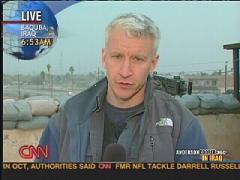
Anderson Cooper Headed to Iraq?

The word on the street is that CNN's Anderson Cooper is headed to Iraq in the next couple of weeks. Hey, I was fine sending John Roberts...not so down with sending Coop. Although, that might mean more face time for Michael Ware and I do love his reporting...

Reporters in Iraq face snipers, roadside bombs and kidnappings


By DAVID RISING
Associated Press Writer

BAGHDAD, Iraq (AP) _ Western journalists covering the war in Iraq face sniper fire, roadside bombs, kidnappers and a host of other dangers. Their Iraqi colleagues must cope with even greater risks, including families attacked in retribution for sensitive reporting, and arrest on suspicion of links to the violence journalists cover.

At least 85 journalists -- mostly Iraqis -- have been killed since the U.S.-led invasion in March 2003 -- more than in either Vietnam or World War II. The security situation is getting progressively worse, and 2006 has been the deadliest year yet, with at least 25 journalists killed to date.

Gunmen carried out the deadliest attack yet on the media on Thursday. Some two dozen armed men, some in police uniform, stormed the downtown Baghdad headquarters of a new satellite television station, killing the board chairman and 10 others.

The motive for the attack on Shaabiya TV was not clear, though there were signs it was carried out by Shiite militiamen. Sunnis say the militias often have help from police. In its few short broadcasts, the station played nationalist music against the U.S. occupation, perhaps prompting militiamen to assume it sympathized with Sunni insurgents.

"Iraq is the most dangerous assignment in the world right now for journalists," said Joel Campagna, head of the Mideast desk of the Committee to Protect Journalists, a New York-based media rights group that keeps the count.

"There really aren't any battle lines. The danger begins right outside your door," he said.

Covering any war is dangerous, and journalists have been killed or wounded in Afghanistan, Sierra Leone, Bosnia and other recent conflicts -- in addition to 66 in Vietnam, 17 in Korea and 68 during World War II.

Western journalists have been targeted in Iraq by insurgents who consider them little different from combatants. Baghdad's Palestine Hotel -- where many media organizations, including The Associated Press, have been based -- was attacked several times including in a triple suicide vehicle bombing last October claimed by al-Qaida in Iraq.

On Wednesday, the body of a Kurdish radio reporter was identified at the Baghdad morgue. Azad Mohammed Hussein was abducted Oct.3 in Baghdad while on his way to Dar al-Salam radio headquarters, and his body was found dumped on Tuesday.

One of Iraq's best-known television journalists, Atwar Bahjat, and two of her colleagues were abducted and slain while reporting on an explosion in February at a mosque in Samarra.

Not all the threats faced by Iraqi journalists come from the insurgents.

In September, Kalshan al-Bayati, whose reporting had been critical of security forces in Tikrit, was arrested twice by the Iraqi army for alleged terrorist links, and remains in custody.

AP photographer Bilal Hussein was detained in April and remains in U.S. custody without any charges against him.

According to CPJ, at least eight journalists have been detained for weeks or months by Iraqi and coalition forces. They include employees of CBS News, Reuters, the AP and Agence France-Presse among others. At least four of the detentions have exceeded 100 days, Campagna said.

In the early months of the war, Western journalists could move about in relative safety in cities like Baghdad, Mosul and even Saddam Hussein's hometown of Tikrit armed with nothing more than a notepad and a pen.

Before the resumption of commercial flights, most journalists arrived in Baghdad by car, either traveling north from Kuwait or east from Jordan along a route that took them near current insurgent hotbeds such as Ramadi and Fallujah.

All that changed in 2004 with an increase in violence, kidnapping and slaying of Westerners. Journalists from the United States, Poland, Japan, Italy and France were kidnapped or killed.

In January, Christian Science Monitor reporter Jill Carroll was abducted by Sunni extremists and freed unharmed 82 days later.

With security in a free-fall, news organizations have taken on extra measures to protect their staff while still reporting as best they can on a complex and violent conflict.

Some journalists, including most freelancers, have left the country. Those news organizations that remain use a handful of U.S. and other Western staffers and rely heavily on their Iraqi reporters, who venture out to the scenes of bombings, suicide attacks and gunfights at great risk.

"The Western reporter has some training on how to cover events in hot areas -- he has better knowledge on when to appear and when to vanish, when there is a danger while covering the news," said Qais al-Azawi, chief editor of Baghdad's al-Jareeda newspaper.

"Moreover, the Western reporters have better protection equipment such as flak jackets. The Iraqi reporters do not have such privileges," he said.

Western journalists, including those from The Associated Press, often live and work in guarded compounds, most outside the U.S.-controlled Green Zone. They venture out to report but usually with armed security escorts.

Security measures to protect staff have driven up costs.

Dexter Filkins, who spent nearly three years covering Iraq for The New York Times, said in a recent talk that his newspaper goes through money like "jet fuel" to protect its reporters in Iraq.

With travel sharply limited, many news organizations, including the AP, periodically embed reporters with U.S. military units. But the number of embeds has waned in recent months from hundreds at a time in the early months of the way to an average of 15 over recent weeks, according to Lt. Col. Barry Johnson, a U.S. military spokesman.

Out in the field, non-embedded journalists are often at scenes of violence and are regularly among the first people there, which can lead to confusion, Johnson said. Insurgents are also known to take videos and pictures of their own attacks to use as future propaganda, and Johnson said soldiers are well within their rights to detain people at the scenes of violence to ensure that they are truly journalists.

"It's a very, very difficult environment and we would rather have our troops be safe by detaining and questioning somebody on why they are there, than let them go and find out they were complicit," Johnson said.

Al-Azawi, the chief editor of al-Jareeda, said in a telephone interview from Paris he is spending more and more time at his home in France for his own safety.

"The warring factions in the country do not respect any law that calls for the protection of the journalists," he said. "Journalism is the most dangerous occupation in Iraq now."

MANIFESTO

Don't think for me. Don't assume what I want to hear or read. Give me facts. Give me reasons. But not yours. Bring me debate. Enlighten me. Today, accountability is masked behind anonymity; bylines are hidden by zeros and ones. Everyone publishes; everyone is "in the know." Ethics are non-existent. Speculation is king. The truth is masked and a hostage. Empowered by our minds, WE ARE THE FREAKSPEAKERS!

FAIR USE NOTICE

This site contains copyrighted material, the use of which has not always been specifically authorized by the copyright owner. We are making such material available in our efforts to advance understanding of issues of environmental, political, news and humanitarian significance. We believe this constitutes a "fair use" of any such material as provided in section 107 of the US Copyright Law. In accordance with the title 17 U.S.C. Section 107, the material on this blog is distributed and available without profit to those who have expressed a prior interest in receiving the included information for research and educational purposes.

If your obsession against us and our content endures, you might find more information at: Law.

If you wish to use copyrighted material from this site for purposes of your own that go beyond "fair use", you must obtain permission from the blog owner.
